.webp)
ASTRE MOBILE - a Moving Work of Art: Paris Design Week 2026 | Hôtel de la Marine, Paris
What happens when a car stops being a machine and becomes a work of art?
At the Hôtel de la Marine on Place de la Concorde, Maison Lacmé offers an unexpected answer. Astre Mobile, conceived and artistically directed by Antoine Tauvel, transforms a transparent automobile into an extraordinary encounter between contemporary design, French craftsmanship and imagination.
Presented for the first time from 9 to 27 September 2026, during Paris Design Week and the European Heritage Days, Astre Mobile occupies the Cour de l’Intendant of one of Paris's most historically charged monuments. The setting is significant: a contemporary object built around movement and experimentation appears within a site deeply connected to France's history of decorative arts and craftsmanship.
The result is neither quite automobile nor sculpture.
It is a cabinet of curiosities on wheels.
Beyond the Art Car
The automobile has long served as a canvas for artistic expression. From the historic Art Car tradition to contemporary collaborations between automotive houses and artists, the car has repeatedly crossed the boundary between industrial object and cultural artefact.
Astre Mobile takes this idea somewhere more intimate.
Rather than simply decorating an existing vehicle, Maison Lacmé reconsiders the automobile through its individual components. The steering wheel, dashboard, gear lever, upholstery, wheels and emblem cease to be anonymous functional elements. They become opportunities for artistic intervention.
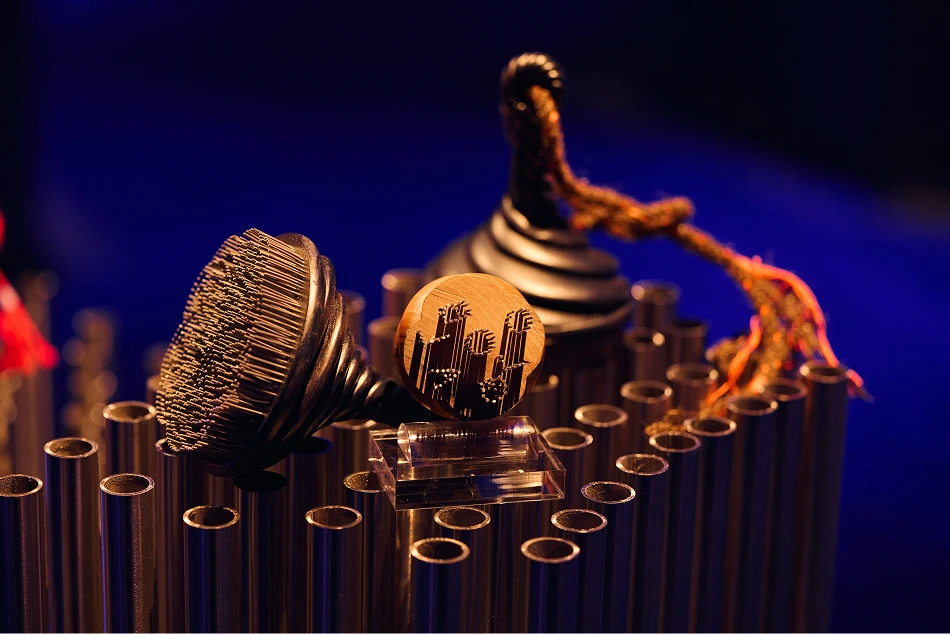
A steering wheel becomes a sculptural object in driftwood.
A gear lever is reimagined in porcelain.
White onyx replaces conventional wheel trims.
A dashboard incorporates feather marquetry.
Leather, shells, lacquer, metal embroidery and gilding enter a vocabulary normally associated with interiors, jewellery, decorative arts and haute craftsmanship.
Each component can be read independently, yet together they form a single work.
This fragmentation is essential to the experience of Astre Mobile.
The viewer is invited not simply to look at the car, but to look again.
Twelve Craftspeople, One Vision
One of the project's strongest dimensions is its collective authorship.
Maison Lacmé brought together 12 exceptional French craftspeople, each contributing a particular savoir-faire to the vehicle. Among them are Maison Vermeulen for feather marquetry, Aurélie Lanoiselée for embroidered shell upholstery, Ateliers Arquié for the porcelain gear lever, Claude Prautois for the driftwood steering wheel, Alexandre Duboc for urushi lacquer, Hervé Obligi for white onyx and Marie Archambaud for metallic embroidery.
The project therefore becomes more than a design object.
It becomes a map of contemporary French craftsmanship.
Every material carries its own history. Every technique represents a particular body of knowledge. Every artisan introduces a different language into the same object.
This is where Astre Mobile becomes particularly relevant to the wider cultural conversation around design today.
The value of the object is no longer determined only by its function, its rarity or its visual impact. It also resides in the knowledge embedded within it.
In an age of accelerated production, Astre Mobile proposes something slower: time, gesture, expertise and human collaboration.
The Luxury of Knowing How
Luxury is often associated with rarity.
Astre Mobile suggests another definition: the luxury of knowing how something is made.
Its materials — onyx, porcelain, wood, leather, feathers, lacquer, shells and gold — are not simply decorative additions. They reveal the processes behind the object.
The car becomes a stage on which craftsmanship can be seen, understood and appreciated.
That distinction matters.
The contemporary luxury sector increasingly speaks about authenticity, traceability, craftsmanship and heritage. Yet these concepts become meaningful only when they are translated into actual creative practices.
Astre Mobile does precisely that.
It places savoir-faire at the centre of the experience rather than treating craftsmanship as a finishing touch.
From Object to Experience
Perhaps the most compelling aspect of Astre Mobile is that its elements are not necessarily imprisoned by their original function.
The project plays with reversibility: certain components can leave the automobile and acquire another life. A wheel trim can become a lamp; a speedometer can become a clock; the automobile's emblem can become a piece of jewellery.
This transforms the relationship between object and function.
The question is no longer simply: What is this object for?
It becomes: What else could it become?
That shift is at the heart of contemporary collectible design.
The object does not have to remain faithful to its original purpose. It can move between categories — furniture, sculpture, jewellery, architecture, design and art.
Astre Mobile exists precisely in this territory between disciplines.
A Dialogue with Heritage
Its location makes the project even more significant.
The Hôtel de la Marine is not a neutral exhibition venue. The monument on Place de la Concorde has a deep connection to France's decorative and material culture. At the end of the eighteenth century, the building housed the Garde-Meuble de la Couronne, the institution responsible for furnishing royal residences and maintaining their furniture. Following the French Revolution, it became the French Ministry of the Navy.
Against this historical background, Astre Mobile becomes a contemporary meditation on the same fundamental question:
How does a culture preserve its relationship with exceptional objects?
The answer is not necessarily through preservation alone.
Astre Mobile takes traditions associated with French decorative arts and places them inside one of the most recognisable products of modern industrial culture: the automobile.
Design as Cultural Dialogue
This is where Astre Mobile becomes particularly relevant to Culture Diplomacy Hub.
For CDH, the project is not simply a story about design, but a story about cultural intelligence.
France's cultural influence has historically been built not only through institutions and diplomacy, but through its ability to communicate ideas of beauty, craftsmanship, refinement and cultural heritage internationally.
Astre Mobile demonstrates how those values can be translated into a contemporary creative language.
The project brings together: French craftsmanship. Contemporary design. Luxury culture. Artistic collaboration. Material heritage. Cultural institutions. And international audiences.
In this sense, design becomes a form of cultural diplomacy.
Not diplomacy through official statements, but through objects, skills and shared cultural experience.
A visitor does not need to speak French to understand the value of craftsmanship. They can see it. They can recognise the time invested in it. And, perhaps most importantly, they can become curious about the culture from which it emerged.
Why Astre Mobile Matters Now? There is something deliberately paradoxical about Astre Mobile. The automobile traditionally represents speed. The craftspeople behind it represent slowness. The car belongs to mass industrial culture. Its individual components belong to highly specialised artisanal practices. It is designed to move. Yet the work asks the viewer to stop.
And perhaps this is its most contemporary proposition. At a moment when design is increasingly concerned with sustainability, material intelligence, longevity and the preservation of knowledge, Astre Mobile asks us to reconsider what we mean when we call something valuable.
Value may not lie in producing more objects.
It may lie in making fewer objects with more meaning.
The Cultural Intelligence of an Object
Astre Mobile ultimately refuses a simple definition. It is a car, but not really. It is sculpture, but it can move. It is design, but it exceeds function. It is luxury, but its real value lies in knowledge rather than excess. It is a collective work, yet guided by a singular artistic vision. And it is contemporary, while drawing deeply on traditions of craftsmanship. This ambiguity is precisely what makes it compelling.
Astre Mobile represents a broader understanding of culture: one in which design is not decoration, craftsmanship is not nostalgia, and heritage is not static.
Culture can move. It can change form. It can enter unexpected spaces. It can travel across disciplines and borders.
And sometimes, in Paris, it can even arrive on four wheels.
Astre Mobile is not simply a car transformed into art. It is a proposition about what happens when an object becomes a meeting point for memory, craftsmanship, imagination and cultural exchange.
At the Hôtel de la Marine, the automobile becomes a vessel.
Not only for movement — but for culture.