Birds of Passage - An exhibition by Laura Dzelzytė and Søren Solkær
In *Birds of Passage*, artist Laura Dzelzytė and photographer Søren Solkær turn migration into a meditation on memory, belonging and the fragile idea of home. Developed in Salento, a region shaped by generations of departure and return, the exhibition brings together two very different artistic languages: Dzelzytė’s sculptural exploration of domestic objects, memory and absence, and Solkær’s mesmerising photographs of starlings moving collectively across the sky.
But this is not simply an exhibition about migration. It is about what migration leaves behind — the houses preserved for those who may never return, the objects that continue to occupy a missing person’s place, and the identities that are reshaped by movement across borders.
The phrase birds of passage once described southern Italians who left their homeland in search of work, often believing that departure would be temporary. Yet return is rarely a reversal of departure. The landscape changes. The traveller changes. And somewhere between the two, belonging becomes less a place than a relationship we continue to reconstruct.
For Culture Diplomacy Hub, this makes Birds of Passage particularly compelling. It asks what culture can do where political language often reaches its limits: create a space in which different histories can recognise one another without becoming identical. Dzelzytė’s own journey — from Lithuania to Britain, Italy and Bhutan — gives this question an unusually personal dimension. Her practice suggests that cultural identity is not fixed by borders, but continually transformed through encounter.
In our conversation, Dzelzytė reflects on art as a form of cultural diplomacy, the emotional architecture of migration, the meaning of restanza — the conscious decision to remain — and what happens when an artwork travels from one cultural landscape into another.
CDH Talks: Before becoming an artist, you worked in international climate policy and diplomacy.
Can contemporary art become a form of cultural diplomacy—as a space where people encounter one another?
Laura Dzelzytė: I spent years in rooms where every word was negotiated. A comma could remain in brackets for days because it represented money, responsibility, history and power. Diplomacy taught me that language is material. It can open a space or close it. It can acknowledge responsibility or quietly remove it.
Art creates another kind of diplomatic room. You enter it through the body, through colour, light, sound, smell or the strange recognition of an object you have never seen before. You do not need to agree on its meaning before something happens between you.
I am suspicious of cultural diplomacy when art is asked to represent a nation as though a country has one face, one history or one voice. I was born in Soviet Lithuania, I live in Britain, and I work in Italy and Bhutan. My identity changes according to where I stand and who is looking at me. I think artworks behave in a similar way.
For me, contemporary art becomes cultural diplomacy when it creates a shared space where each person remains complex. The work does not deliver a message from one country to another. It becomes a portal through which people encounter one another and perhaps leave carrying a small part of somebody else’s reality.
CDH Talks: Having experienced both, how would you define “cultural diplomacy” today?
Laura Dzelzytė: Cultural diplomacy is a relationship built through attention.
In political diplomacy, countries arrive with positions. In art, we can arrive with questions. Who has been heard? Who has been translated? Who owns the objects, images and stories being presented? What happens to the knowledge after the exhibition closes and everyone goes home?
I think cultural diplomacy today must be porous. Donna Haraway writes about boundaries between nature and culture, organism and environment, as fictions sustained by human narratives. National culture can also be treated as something contained within a hard outline, arbitrarily drawn through historical events and circumstances. Yet culture is fragmented and always moving. It moves through migration, trade, religion, marriage, conquest, recipes, songs, textiles and the private memories carried within families.
I am interested in projects that allow all these movements to remain visible. Cultural diplomacy happens when we create something together and accept that the encounter will change everyone involved. It requires trust, time and humility. You enter another cultural space knowing that it already possesses its own intelligence. Your first responsibility is to listen.
CDH Talks: Lithuania, Italy, Bhutan and the UK appear in very different ways within your practice.
What happens toan artwork when it travels between cultures?
Laura Dzelzytė: It sheds one skin and grows another.
Wax is a good example. In Lithuania and Italy, a wax figure can immediately enter the visual language of Catholic devotion, relics, candles and the body of Christ. In Britain, the same material may evoke preservation, from the tackiness of Madame Tussauds to something more bodily and slightly uncanny. In Bhutan, light, emptiness and the transformation of matter carry another spiritual and philosophical resonance. The material remains wax, yet the work has already changed through the way it activates the surrounding heritage.
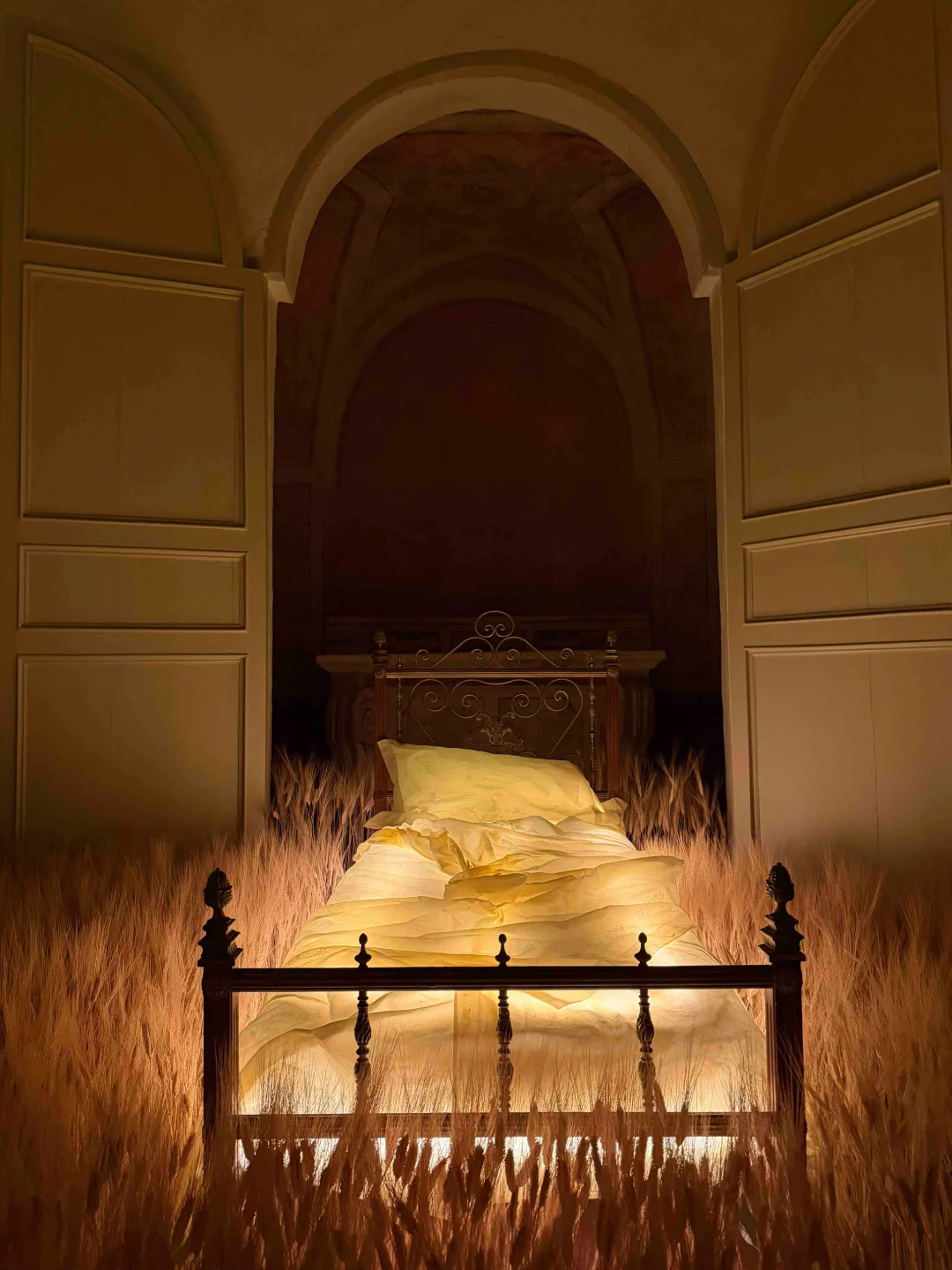
In the Salento Trilogy, the antique bed reimagined in wax became connected to migration and to the rooms people left behind. Someone departs, while the bed remains within the family house. The person may never sleep in it again, yet it continues to hold their place.
I think an artwork is completed many times by the people who encounter it. Each place adds another layer, including layers I cannot fully know or control. That is the generosity of travel. The artwork becomes less obedient to its author. It begins to carry several worlds at once.
CDH Talks: Do you believe cultural encounters can genuinely change how we understand another country—or even how we understand ourselves?
Laura Dzelzytė: Yes, because another culture can become a mirror held at a different angle.
I arrived in Salento thinking about southern Italian emigration. Very quickly, I began recognising Lithuania. I recognised the attachment to land, the houses maintained for people who had left, the food prepared for their return, and the emotional weight carried by those who stayed. These histories are distinct, and there was still a bodily recognition between them.
Working with Bhutan makes me question the assumptions I carry from Europe about progress, modernity, spirituality and the role of culture. Sometimes you only discover the architecture of your own thinking when you enter a place built around another set of relationships.
A meaningful cultural encounter disturbs something gently. It moves a piece of furniture in the mind, and suddenly the room looks different. You may begin by trying to understand another country and discover that your own identity is less fixed than you imagined. I find that deeply hopeful. It means we are permeable. We can still be affected by one another.
CDH Talks: Your current project, Birds of Passage, engages with southern Italy and histories of emigration and return.
What did this landscape reveal to you about departure, belonging and return?
Laura Dzelzytė: I was deeply affected by Atrabiliarios (1992–2004), an elegy for the desaparecidos (the disappeared) of Colombia's armed conflict by Doris Salcedo. People departed, yet their place at home was preserved through objects and memory. In Salento, absence has a physical presence. It lives in closed houses, old photographs, embroidered linen and stories about relatives who left for Switzerland, Germany, Britain or America.
The title Birds of Passage comes from a historical phrase used to describe southern Italians who travelled abroad for work. Many believed their departure would be temporary. Some returned. Many never did.
Whether in Nobgang, high in the Bhutanese Himalayas, or Matino in southern Italy, spending time living with families, sharing meals, coffee and stories with women, participating in rituals, and engaging in the act of making itself are important parts of my practice.
For the Salento Trilogy, I spent time with Johnny D’Ercole, a third-generation furniture restorer from Lecce, who told me stories of abandoned grand houses where magnificent pieces of furniture were sold off. Together, we selected an Italian Liberty-period wooden and brass bed to be reimagined.
I also spent time with Giorgia Ferraro and her family. I learned from her mother how to dress a bed with traditional Salento linen, placing the embroidered side of the pillowcase face down. I then remade the linen in wax. A team of young volunteers helped me create a field of wheat by placing 14,000 stems. These are ordinary materials connected to the body and the home. The bed glows as though it remembers the person who slept there. Wheat surrounds it like a landscape, a harvest and a sea that must be crossed.
Salento also gave me the word restanza: staying as a conscious, active relationship with a place. I began thinking about those who remain, especially the women who maintain houses, objects, rituals and family memory. Staying also requires endurance.
Return is never a simple reversal of departure. The place has changed, and so has the person coming back. You return to something real and something imagined. Perhaps belonging exists within that tension: between the home that remains and the home we continuously reconstruct inside ourselves.
CDH Talks: If you could send one cultural object, story or idea across a border as an ambassador of humanity, what would you choose—and why?
Laura Dzelzytė: I would send an old piece of hand-embroidered textile.
Perhaps it would be a bedsheet or a child’s christening gown, handmade and repaired over several generations. Linen seems fragile, yet it survives. It absorbs the smell of bodies, domestic spaces, smoke and soap. It remembers folding. It carries the pressure of hands.
Official history gives us treaties, monuments and the names of powerful men. A piece of domestic cloth holds another archive: birth, sleep, illness, sex, care, migration and death. It holds the repetitive labour of women, which has sustained human life while remaining largely invisible.
I use linen in my work because it can become almost ghostly. When saturated with wax and illuminated, it appears to contain a body even when the body is absent. It crosses the border between object and presence, between the domestic and the sacred.
I would send it without an explanation. Most people would recognise something within it through their own family histories. It would speak quietly about vulnerability, care and continuity—the things human beings carry across borders even when almost everything else has been left behind.
CDH Talks: How did the Southern Italian Baroque influence the paintings you created during the Salento residency?
Laura Dzelzytė: Southern Italian Baroque is excessive, theatrical and bodily. I wanted the paintings to carry that tension between splendour and collapse. While the wax installation contemplates what remains behind, the smaller studies and large-scale paintings address the inner turmoil of the person who leaves.
The figure on the gold ground meditates on migration as a loss of identity and an impending loss of home. In the smaller studies, the figure becomes headless, marked by a red interruption. In the larger painting, he retains his head, as though he still occupies the moment before departure. In the second painting, an abstracted body carries a mass of wheat and gold: harvest, wealth, memory and burden.
I begin these paintings with the structure of classical drawing and then partially obliterate it with colour, gesture and energy. For me, this is where the Baroque becomes contemporary: the body is caught within forces greater than itself - faith, money, movement, desire and loss. Yet it continues to resist complete erasure.
MACMa - Museo d’Arte Contemporanea di Matino 10 August - 9 September
Castello Angioino di Copertino 11 September - 10 October