Charlie Stein on Art, Technology and The Future of Perception
The digital image no longer simply represents the world. It circulates through it, shapes desire, constructs identities, stores memory and increasingly participates in how reality itself is understood.
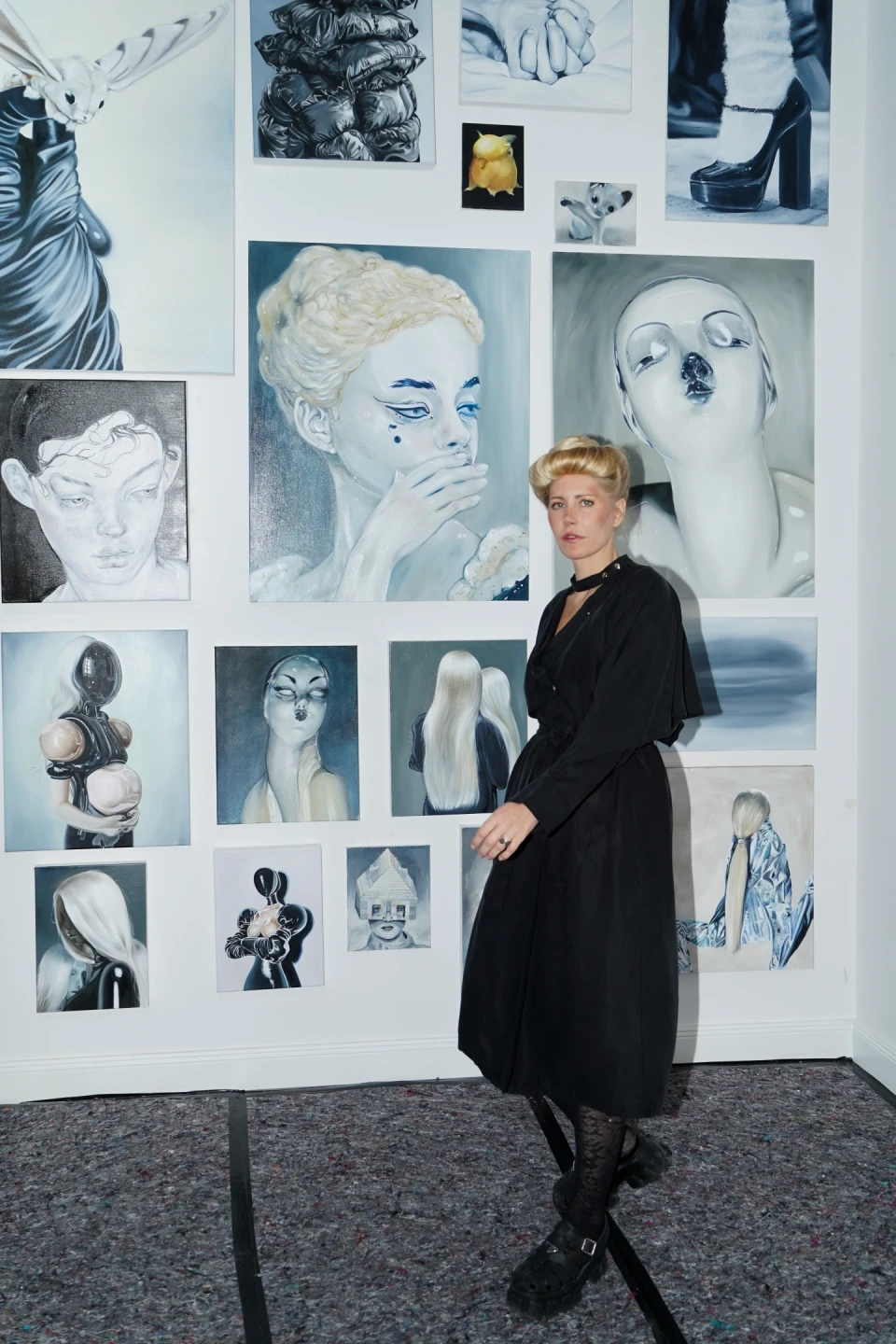
For artist Charlie Stein, this transformation is not a reason to abandon painting, but to reconsider what painting can mean in an image-saturated culture. Working in oil on canvas, Stein explores the relationship between digital imagery, perception, intimacy and the enduring materiality of the painted image.
In this conversation for Culture Diplomacy Hub, Charlie Stein reflects on what happens when images become easier to produce than ever before, while meaning remains difficult to manufacture. She considers AI and the future of artistic authorship, the relationship between technology and cultural memory, and the tension between unprecedented cultural access and the homogenising force of global platforms.
Her reflections also raise a broader question for cultural diplomacy: if technology allows images, ideas and cultural forms to travel almost instantaneously, what happens to difference along the way?
Rather than treating technology simply as either threat or progress, Stein looks at the friction between access and autonomy, circulation and preservation, production and meaning — and asks what might still distinguish a human image in a world capable of generating almost anything.
CDH Talks: When did the digital image stop being a representation of reality and become reality itself?
Charlie Stein: Did it? I would argue that the digital image has always been a reality in itself. What changed was perhaps not the image, but our cultural understanding of it. It took contemporary culture roughly a decade to widely acknowledge that digital images don't simply represent reality: they circulate, accumulate value, produce desire, shape memory and have very real consequences.
My own work approaches this condition through painting. I work in oil on canvas, and I'm interested precisely in what happens when images shaped by digital culture are translated into one of our oldest and most durable image technologies. For me, painting isn't an escape from the digital image but another way of transporting, storing and materialising it.
CDH Talks: What happens to intimacy when more of our identities are constructed through screens?
Charlie Stein: I think the sentence "life imitates art" comes to mind. Back in the day, people couldn't appreciate mountains as a desirable vantage point; only through landscape paintings did they become something desirable to look at. Some people even claimed the mountains were horrid and refused to look out of the carriage when travelling across the Alps, so they wouldn't have to see the ugliness.
The same is true for constructed identities, and not only since the rise of new technology. The idealisation of man is as old as time. In Greek sculpture, we find ideal forms presented to the onlooker as the desired body; in ancient philosophy, we find ideas about the character a person should possess in order to be considered attractive or good.
Depictions on screens may multiply these ideal forms, but in no way are they new fictions — they are re-heated fictions from the past. Demure and beautiful women, strong and wealthy men: these stereotypes have been perpetuated for as long as history records.
The thing with true intimacy is, and perhaps always will be, a conscious decision of the self to step outside societal norms and stencils — or to accumulate and layer them in such a unique way that they create a new personal reality. Intimacy means being able to show yourself as something other than an ideal form: the sick body, the ugly nature, a particular trait or thing that belongs only to oneself at one very specific moment in time.
It's when the performance stops for an instant and something else becomes visible. It's a theme I try to capture in my paintings over and over again.
CDH Talks: What can painting still do that an algorithm cannot?
Charlie Stein: Just as we get excited when Usain Bolt wins a race, even though a missile is much faster, we still want to see what humans can achieve sans aid. I don't think that desire will disappear simply because machines become capable of producing increasingly sophisticated images.
Instead, the act of choosing imagery will be even more important when "anything could be depicted". The question of "why" will be heard louder than ever before.
The lifetime of a human is finite — that's why human images will always matter more to us, because artists pour their finite hours and days into these objects. Additionally, painting has proven to be one of the best storage mediums we have. Restorers can restore a painting that has been around for centuries, as opposed to obsolete digital or virtual media.
CDH Talks: Does AI change the artist, or does it expose what the artist has always been doing?
Charlie Stein: I don't know. I think it depends entirely on the individual artist. A bad artist will be a bad artist, whether it's 1789 or 2026. A new tool doesn't suddenly give someone something interesting to say.
What I do find a little sad to watch is how work that would previously have gone to illustrators, photographers or artists is increasingly being replaced by AI. And not because the results are necessarily better, but because they're faster and cheaper. Most of it is incredibly uninspiring and boring.
Perhaps that's where AI does expose something: it makes the distinction between producing an image and having an artistic position much more obvious. Making images has become easier than ever. Having something to say with them hasn't.
CDH Talks: What happens to personal memory, lived experience and cultural heritage when access to the archive becomes easier than remembering?
Charlie Stein: I wish I could answer that. In the best-case scenario, people will ask AI what to do when they're uncertain, and it will draw on an enormous archive of accumulated human knowledge and experience. Perhaps remembering will become less about what an individual can retain and more about knowing how to access what humanity has retained.
The worst-case scenario would be the complete dismantling of society and the downfall of humanity.
CDH Talks: Through your experience so far, in what ways have you observed technology creating new forms of cultural diplomacy while also accelerating cultural homogenisation?
Charlie Stein: I think technology does both, but I'm increasingly interested in whether a certain amount of gatekeeping might actually be necessary.
We tend to think of access as inherently positive and gatekeeping as inherently negative. But barriers also protect difference. A culture that isn't immediately accessible, translatable or consumable retains a certain autonomy.
Technology has created an extraordinary cultural proximity. I can sit in my studio in Berlin and encounter an artist in Seoul or an archive in New York almost instantaneously. That can be a powerful form of cultural diplomacy. But at the same time, everything enters the same platforms, the same algorithms and increasingly the same visual language.
Perhaps the problem isn't cultural exchange itself. Art history has always been built on exchange, borrowing, translation and even misunderstanding. The difference is speed. Historically, ideas travelled and changed on the way. Now they can arrive everywhere almost simultaneously and almost unchanged.
So perhaps we need to reconsider gatekeeping not simply as exclusion, but sometimes as friction — something that slows cultural circulation down enough for difference to survive.
CDH Talks: If the future gives us infinite images, infinite archives and increasingly intelligent machines, what do you believe will remain uniquely human in art?
Charlie Stein: I'm not sure I agree with the premise of "infinite images," or at least with what infinity means here. We may be able to generate an infinite quantity of images, but quantity and imagination are not the same thing.
I actually think human ideas might be infinite. Every new historical moment, technology, relationship or experience changes the context in which an image can exist and therefore what it can mean.
What interests me about AI at the moment is that, despite its seemingly limitless capacity for production, it often gravitates towards increasingly stereotypical and normative solutions. Infinite output can still produce remarkable sameness.
And none of these images appear from nowhere. They emerge from art history and from our collective cultural production — photography, cinema, advertising, illustration, painting. They are already full of human history and context.
So perhaps the question for me isn't what will remain uniquely human once machines can produce infinite images. Producing images was never the entirety of art. What matters is why someone makes, chooses or encounters a particular image at a particular moment — and what they make it mean.