Cipriani Venice: Where Hospitality Becomes Cultural Memory
There are hotels that offer a view of Venice, and then there are places that seem to have absorbed something of the city itself.
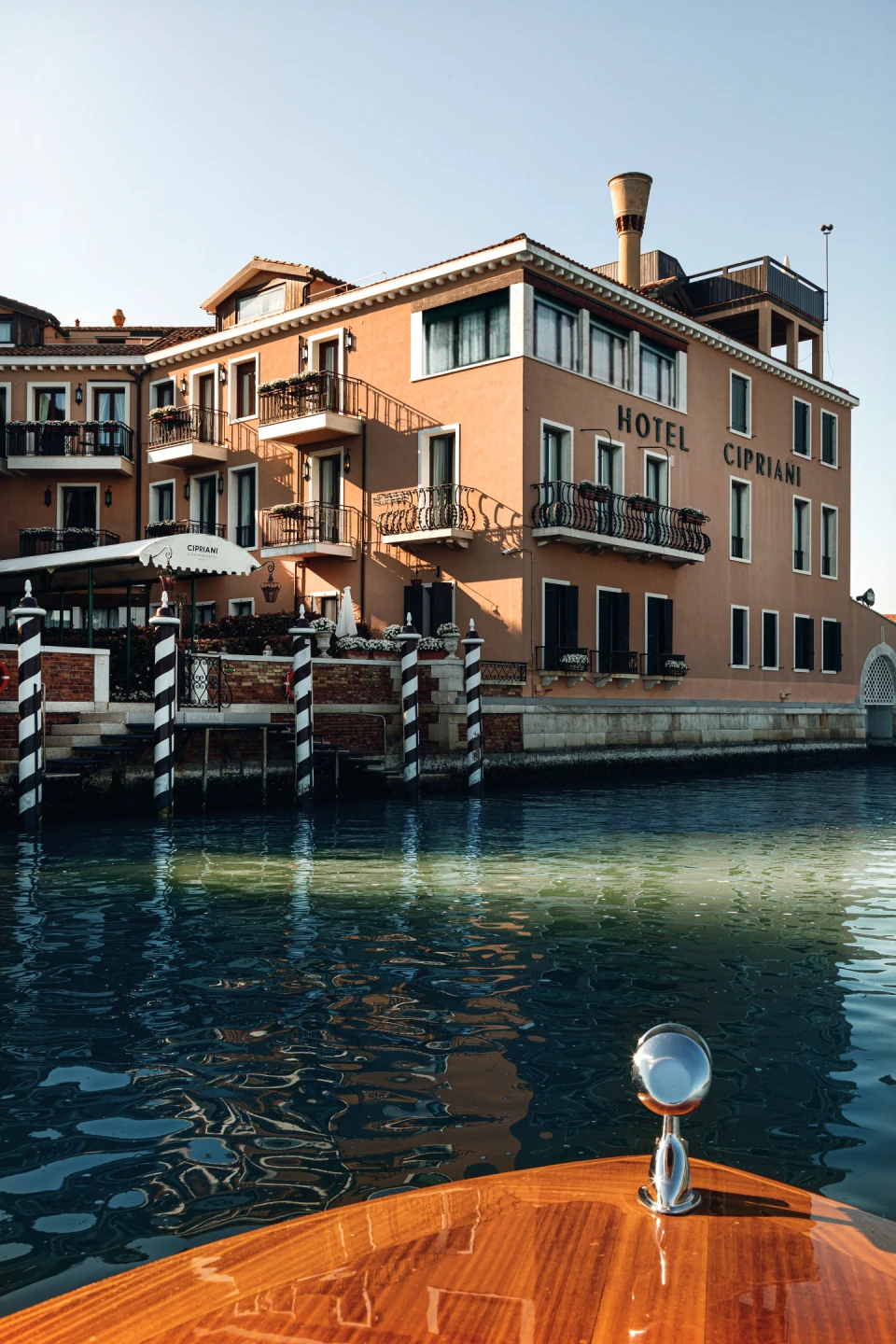
On the eastern tip of Giudecca, across the lagoon from Piazza San Marco, Hotel Cipriani, A Belmond Hotel occupies an unusual position in the Venetian landscape. It is close enough to the city to belong to its mythology, yet sufficiently removed from its crowds to create another version of Venice — quieter, more private, almost cinematic.
The journey begins before arrival. A short boat ride across the lagoon separates the hotel from San Marco, turning transportation into part of the experience. Venice slowly recedes behind you, and the Cipriani appears less like an address than an enclave: gardens, water, stone, light and the unmistakable silhouette of the city beyond.
That separation is fundamental to understanding the hotel's identity.
A hotel born from a Venetian idea
The story of Cipriani is inseparable from Giuseppe Cipriani, the founder of Harry's Bar. In 1931, he opened the legendary bar near Piazza San Marco, creating a place that would become a meeting point for writers, artists, aristocrats, actors and cultural figures. Harry's Bar was subsequently recognised by the Italian Ministry of Cultural Heritage as a national landmark in 2001.
More than two decades later, Cipriani imagined something different: a hotel that would retain proximity to Venice while escaping its intensity. The result was Hotel Cipriani, established on Giudecca in the late 1950s. Its location was not incidental. The idea was to create privacy without isolation — a retreat from the crowds, but never a retreat from Venice itself.
That distinction still defines the property. Cipriani does not attempt to reproduce Venice inside the hotel. Instead, it frames it.
The lagoon becomes the architecture's natural backdrop. The gardens create a sense of Mediterranean abundance. The boat becomes the corridor connecting private life with the public theatre of the city.
It is luxury through distance rather than accumulation. The art of not trying too hard Perhaps the most interesting thing about Cipriani is what it refuses to do.
In an era when luxury hotels increasingly compete through spectacle, Cipriani's vocabulary is quieter. Its identity comes from proportion, service, craftsmanship and atmosphere rather than visual excess. This is particularly relevant in Venice, where any attempt to compete with the city itself would be almost absurd.
Architect and designer Peter Marino's recent intervention understands precisely this problem. His work draws upon three distinct layers: the grandeur of historic Venice, the Dolce Vita period of the 1950s and 1960s, and the energy of contemporary art and design. The first phase of the renovation introduced a new light-filled arrival space alongside the preservation of the hotel's original wooden reception, as well as redesigned suites and rooms.
The approach is less about reinvention than continuity. As Marino has suggested, Venice presents both the challenge and the opportunity: one cannot compete with centuries of beauty; one has to enter into a conversation with it. That idea could almost serve as Cipriani's design manifesto.
From Dolce Vita to contemporary cultural capital
Cipriani's cultural relevance also lies in its relationship with the people who have passed through its doors.
Long before Venice became one of the world's most photographed luxury destinations, the hotel had already cultivated a clientele of artists, actors, royalty, political figures and international tastemakers. Its mythology developed alongside the city's own transformation into a global cultural stage. Today, that relationship feels particularly significant. Venice is no longer simply a destination. It is an international platform for cultural exchange: the Biennale, the Mostra del Cinema, architecture, design, contemporary art, fashion and an increasingly sophisticated cultural tourism economy all converge here. Cipriani sits at an intriguing intersection of those worlds.
It offers something that many contemporary luxury properties struggle to manufacture: cultural credibility accumulated over time. The hotel is not merely positioned within Venice's cultural ecosystem. Its history has become part of that ecosystem.
Luxury as cultural diplomacy
This is where Cipriani becomes particularly interesting from a Culture Diplomacy perspective.Hospitality is often discussed as a commercial category. But historically, the great European hotels have also functioned as informal diplomatic spaces — places where artists meet collectors, politicians encounter cultural figures, business leaders cross paths with creatives, and international networks are formed through seemingly casual encounters. Cipriani belongs to this tradition.
Its significance is therefore not only architectural or gastronomic. It lies in its ability to create social infrastructure for cultural exchange. The hotel becomes a stage on which different forms of cultural capital meet: Italian craftsmanship, international wealth, contemporary art, cinema, fashion, gastronomy and the symbolic power of Venice.
This is perhaps the more interesting definition of modern luxury. Not simply having access to beautiful things, but having access to places where meaningful relationships happen.
The Venetian paradox
There is an inherent paradox at the heart of Cipriani. Venice is increasingly confronted with questions of overtourism, preservation and the commodification of cultural heritage. Yet the city's global appeal depends precisely on its ability to remain desirable to visitors. Cipriani proposes one possible answer: proximity without intrusion.
From Giudecca, the visitor remains connected to Venice while experiencing a slower rhythm. The hotel currently describes itself as a Venetian oasis, with private gardens, lagoon views, a large saltwater pool, multiple restaurants and bars, and a direct boat connection to San Marco.
The experience is therefore not about conquering Venice. It is about observing it. And perhaps that is why the hotel has endured.
A living piece of the Venetian imagination
The real achievement of Cipriani is not that it has remained luxurious. Luxury, after all, can be purchased, redesigned and reproduced. What cannot easily be reproduced is memory.
Cipriani possesses layers of it: Giuseppe Cipriani's original vision, the post-war optimism of the Dolce Vita years, the mythology of Harry's Bar, decades of international guests, the craftsmanship of Venice, and now a contemporary design language capable of speaking to a new generation.
The hotel therefore occupies a fascinating space between preservation and reinvention. It does not belong entirely to the past. Nor does it need to chase the future.
Instead, it continues to do something distinctly Venetian: to allow different eras, cultures and people to meet on the same piece of water.
And perhaps that is the most enduring form of luxury Venice can offer — not escape from culture, but privileged access to it. Cipriani is not simply a place from which to see Venice. It is one of the places through which Venice continues to tell its story.