Concerning Unknown Women: On the Lives History Leaves Out
Whose lives become part of history, and whose remain confined to fragments of names, dates and institutional records? The question lies at the heart of Concerning Unknown Women, an artistic project that revisits the lives of women who entered religious communities in seventeenth- and eighteenth-century Leuven, Belgium.
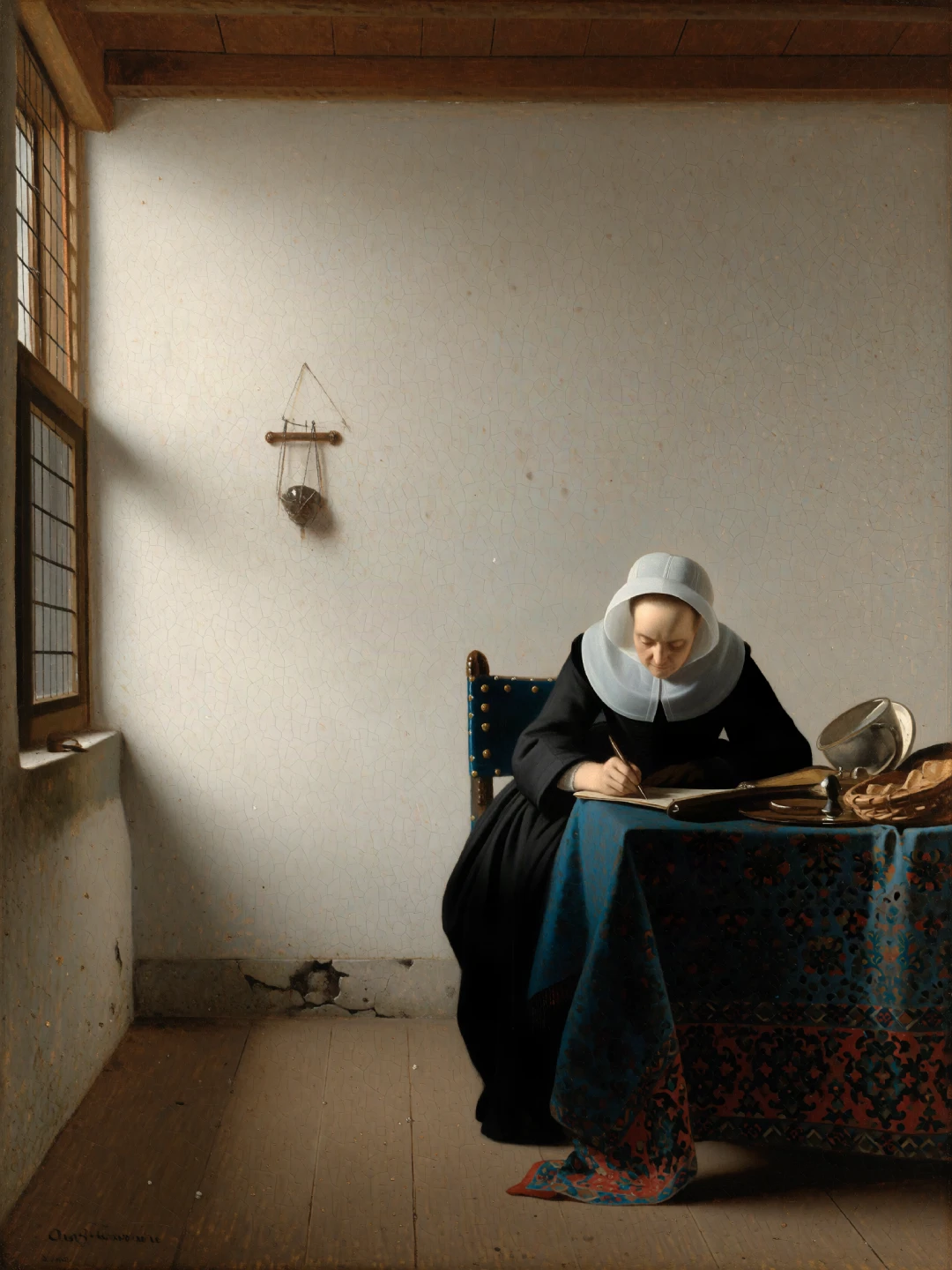
Developed in response to a collection of commemorative poems preserved at Park Abbey, the project explores the distance between historical documentation and the individual lives it seeks to represent. Using generative artificial intelligence trained on historical Flemish portraiture, the artist creates speculative portraits of women engaged in acts of reading, writing and making — gestures that suggest intellectual curiosity and personal agency largely absent from the records that have survived.
Rather than attempting to reconstruct identities that can no longer be fully recovered, Concerning Unknown Women questions the ways historical narratives are constructed, interpreted and institutionalised. It also raises a more contemporary dilemma: can we challenge the silences of the past without projecting the assumptions of the present onto it?
In this conversation with Culture Diplomacy Hub, we explore the relationship between historical memory, women's intellectual and spiritual lives, institutional authority and the possibilities of artificial intelligence in contemporary artistic practice. At its centre is a question that extends beyond the historical experience of women: how do we give space to lives that history has preserved, but never fully allowed us to know?
CDH Talks: When examining the lives of women who entered religious life in the seventeenth and eighteenth centuries, to what extent can we genuinely understand their motivations, and to what extent are we reconstructing them through categories that belong to our own time?
Where is the boundary between historical reconstruction and the projection of contemporary perceptions of women's experiences?
Ana Maria Caballero: Concerning Unknown Women began as one of the site-specific commissions for Threading Landscapes, an exhibition at Museum PARCUM, housed within Park Abbey in Leuven, Belgium. Curated by Katya García-Antón, María Inés Rodríguez, Ana Sokoloff and Daniel Feldman, the exhibition celebrates the completion of a fifteen-year restoration of the Abbey, founded in 1129.
I was invited to respond to the Abbey's collection of poems commemorating women entering religious life, primarily during the seventeenth and eighteenth centuries. I was quite disappointed when I realized I was essentially reading the same poem over and over again. Different women, different names and dates, but almost identical descriptions of religious devotion. The poems preserved their names while leaving little to no trace of who they were as individuals.
My project imagines what the records leave out. It doesn’t claim to recover what was lost. Working with TITLES, my longtime technology partner, I developed a custom AI model trained on historical Flemish portraiture, with a twist: in our portraits, the women are reading, writing, drawing, making things.
These are activities they could very plausibly have pursued, even if the visual and written records of their time rarely acknowledged their agency. I'm not imposing contemporary values on these women by imagining them as intelligent and curious. Women have always had rich inner lives. Historical records have often failed to represent them.
CDH Talks: Historical canons are not neutral, but neither is their contemporary reassessment necessarily free from ideology.
Are we merely changing the criteria by which history is evaluated, or are we genuinely changing the way we understand history?
Ana Maria Caballero: My project makes visible the ways we construct our understanding of history, inviting us to examine what we know about the past and how we’ve come to “know” it. I don't pretend to change history. I'm introducing alternative narratives that might expand our reading of it.
The installation includes a bibliography of works we now call “protofeminist,” written by women who challenged prevailing ideas about their place in society long before the word “feminism” existed. This classification is retrospective, a reminder that the categories through which we understand history belong to particular moments in time.
The way we collect and present historical material shapes which lives acquire significance. My speculative portraits are housed in an imagined museum website that borrows the visual language of institutional cataloguing to make that process visible, while proposing a place for women whose names survived but whose individual stories did not. It's an attempt to question who belongs in the historical canon and how a canon is built in the first place.
CDH Talks: If historical records are shaped by social power relations, how can we be certain that their critical interpretation today does not reproduce the same mechanisms, albeit from a different ideological standpoint?
Ana Maria Caballero: We can't be certain, and my project doesn't pretend otherwise. The Abbey's poems described different women in almost identical terms, but I don't want to replace their ideal of religious devotion with an equally uniform contemporary ideal of independence. The imagined portraits suggest rich interior lives, something I feel very strongly women have always had.
By openly identifying the portraits as speculative, I keep that uncertainty present. I don’t offer my project as another authoritative account of who these women were. I think of the portraits as tender homages to the lives that existed beyond the descriptions preserved in the Abbey.
CDH Talks: Is there a risk that contemporary research into women's experiences, in its effort to address their historical invisibility, may begin producing new, equally simplified narratives about women as a universal category?
Ana Maria Caballero: How can imagining women as individuals, each with her own intellectual interests, desires and private thoughts, amount to another simplified narrative? What struck me about the religious poems was that they were the same poem with different names and dates, preserving individual identities only to make them indistinguishable.
The portraits do the opposite. I'm not proposing a new universal account of womanhood. I'm questioning why historical records have so often denied women the complexities of selfhood.
CDH Talks: What is the relationship between human intelligence and these same questions?
To what extent can human thought transcend inherited patterns, ideological assumptions and the limitations of its own historical and cultural context?
Ana Maria Caballero: As someone working with generative AI, I'm accustomed to hearing that machines reproduce stereotypes. The Abbey's poems reminded me that humans have been flattening narratives for centuries. The problem precedes technology.
Neither human nor machine intelligence escapes inherited patterns, but recognizing those patterns allows us to question what we do with them. In Concerning Unknown Women, a model trained on historical painting becomes a way of imagining possibilities beyond the conventions of that very tradition.
CDH Talks: When historical narratives are reproduced, does the problem lie in their content or in society's very need to maintain stable narratives about the past? Is it possible to have a historical memory that is not selective?
Ana Maria Caballero: I doubt historical memory can ever be unselective, nor do I think selection is the problem. The difficulty arises when we mistake what has been preserved for everything there is to know. The Abbey's poems are beautiful documents that have kept these women's names alive for centuries, but their repetition also reveals how much can disappear within the act of record-keeping.
CDH Talks: How can we distinguish historical relativism from a genuine effort to understand the past within the circumstances of its own time?
Ana Maria Caballero: My research into the religious communities of Leuven, particularly its beguinages, complicates assumptions about the choices available to women. Religious life could offer forms of independence unavailable elsewhere, and what might look like a restriction from our perspective could have represented an opportunity for some women.
This research informed the portraits I developed with TITLES, particularly the women's clothing, but the distinction between historical evidence and artistic speculation remains essential. I imagine what these women might have done on a typical afternoon. I don't pretend to know why they entered religious life.
CDH Talks: What separates a religious woman who lived in a monastic order in the eighteenth century from a religious woman today?
Ana Maria Caballero: In my video poem Thin Lines, an imagined professor of early modern literature encounters the speculative museum website for the first time. As she reads about these women, her own experiences of religious devotion, doubt and loss enter the poem, raising the question of how much of another person's spiritual life we can ever understand, regardless of the century in which she lived.
CDH Talks: What place does the contemporary woman seek within that system?
Ana Maria Caballero: I don't think there is a single “place” that contemporary women seek within religion, any more than the women in the Abbey's records sought the same things. In Thin Lines, an imagined professor of early modern literature becomes a contemporary reader of their lives, navigating the speculative museum website through clicks, pauses and returns.
Her encounter is informed by the books she’s read, including works from the project's bibliography, which gathers writing by and about women from medieval authors to Mary Wollstonecraft. Her experiences of faith and loss shape the way she interprets the site, until she finds herself wondering how someone might one day read the traces of her own life.
Thin Lines is a choreography of contemporary readership, particularly of how browsing a website resembles reading a choose-your-own-adventure book. Each visitor takes a different path. I call the ways readers and writers collaborate in the construction of meaning analog generativity. The contemporary woman is not the subject of interpretation: she’s its author.