Erwin Wurm at Museo Fortuny, Venice
In Venice, where nothing is ever entirely solid — not the ground beneath the city, not the boundaries between past and present, nor even the buildings that appear to defy time — Erwin Wurm's sculpture finds an unusually precise setting.
At Museo Fortuny, the Austrian artist brings together the body, the everyday object and the absurd to question one of sculpture's oldest assumptions: that a sculpture must be a thing. In Wurm's work, it can instead be a gesture, a posture, a piece of clothing, an unstable body — or a moment that exists only long enough to be photographed.
Placed within the former Palazzo Pesaro degli Orfei, Mariano Fortuny's extraordinary laboratory of art, design, fabric and invention, Wurm's work acquires another dimension. Here, ephemerality encounters history; the weight of the museum meets the precariousness of the human body.
The result is not simply an exhibition, but a conversation across time about how we occupy space, construct identity and, perhaps most revealingly, perform ourselves.
The sculpture that refuses to stay still
Erwin Wurm has spent much of his career dismantling the stability traditionally associated with sculpture.Born in Austria in 1954, Wurm emerged internationally through a practice that deliberately unsettles categories: sculpture becomes performance, performance becomes photography, clothing becomes architecture, and the human body becomes material. His work is often immediately accessible because it begins with objects that require no specialised knowledge.
A chair, a bottle, a jumper, a cushion or an ordinary piece of clothing belongs to the visual vocabulary of everyday life.But familiarity is precisely the point. The ordinary is so close to us that we stop seeing it. Wurm's strategy is to interrupt that familiarity. He makes the ordinary awkward.A chair is no longer simply something to sit on. A garment no longer simply covers a body. A cushion can acquire limbs. A person can become an object.
The resulting humour is deceptively simple. Beneath it lies a more serious investigation into the systems that organise contemporary existence: consumption, social conformity, physical appearance, productivity and the construction of identity. Wurm's absurdity is therefore not an escape from reality. It is a way of looking at reality more accurately.
The body as temporary architecture
This becomes most evident in Wurm's celebrated *One Minute Sculptures*, presented on the museum's second floor. The premise is almost disarmingly modest. The artist provides instructions. The visitor follows them. An everyday object is placed in relation to the body. The body assumes an unusual position. For one minute, the visitor becomes the sculpture. Then it is over. This simple mechanism radically changes the traditional relationship between artwork and spectator. The visitor is no longer outside the work, looking at an object. The visitor becomes the object through an act of participation. The sculpture has no independent existence. It requires the body, time, a willingness to look slightly ridiculous. That last element is essential.
Wurm introduces humour into the museum precisely because humour destabilises authority. The museum traditionally asks us to behave with a certain seriousness: to stand at an appropriate distance, lower our voices, observe, interpret. Wurm asks us to pose. Suddenly the viewer becomes part performer, part object, part spectacle.
The awkwardness is not incidental. It exposes something about the social body — the way human beings constantly adjust themselves according to invisible instructions. Stand like this. Dress like this. Look like this. Behave like this. Be successful like this. Be desirable like this. The ‘’One Minute Sculptures’’ turn those invisible instructions into literal ones. And for sixty seconds, the museum becomes a rehearsal space for contemporary identity.
From performance to photographic evidence
There is another important transformation taking place. The action disappears, but the photograph remains. Wurm's use of photography, particularly the immediacy of the Polaroid, gives the ephemeral sculpture a strange afterlife. The photograph becomes evidence that the gesture occurred. It is almost a form of visual taxidermy: the moment is dead, but preserved.
This distinction matters. The sculpture itself is temporary. The image is permanent enough to circulate. The work therefore anticipates something that has become central to contemporary culture: the transformation of experience into documentation. Today, much of life is experienced with the camera already present. We travel and photograph the journey.
We eat and photograph the table. We attend an exhibition and photograph ourselves inside it. We do not simply experience an event; we produce evidence of having experienced it. Wurm's practice, developed decades before the dominance of social media, becomes strikingly contemporary in this context. His ‘’One Minute Sculptures’’ ask a question that now feels almost unavoidable: If an experience is not documented, does it still possess the same cultural value?
The absurdity of the everyday
Wurm's humour is often what makes his work immediately approachable. But to reduce the work to humour would be to miss its critical dimension. The joke is the entrance, not the destination. His distorted objects and precarious bodies expose the absurdity already embedded in ordinary life. This is particularly relevant to Wurm's engagement with consumer culture.Modern capitalism has transformed objects into carriers of identity. What we buy is rarely presented as merely functional. Objects promise status, taste, youth, belonging and distinction.
The object becomes a language through which we construct ourselves. Wurm reverses this relationship. Instead of allowing objects to define the human being, he gives them human characteristics and places the human body into absurd relationships with them. The result is a subtle collapse of hierarchy. Who possesses whom? Do we use objects, or do objects increasingly organise our lives? Wurm does not offer a moralistic answer. He stages the contradiction.
Dreamers and the psychology of the object
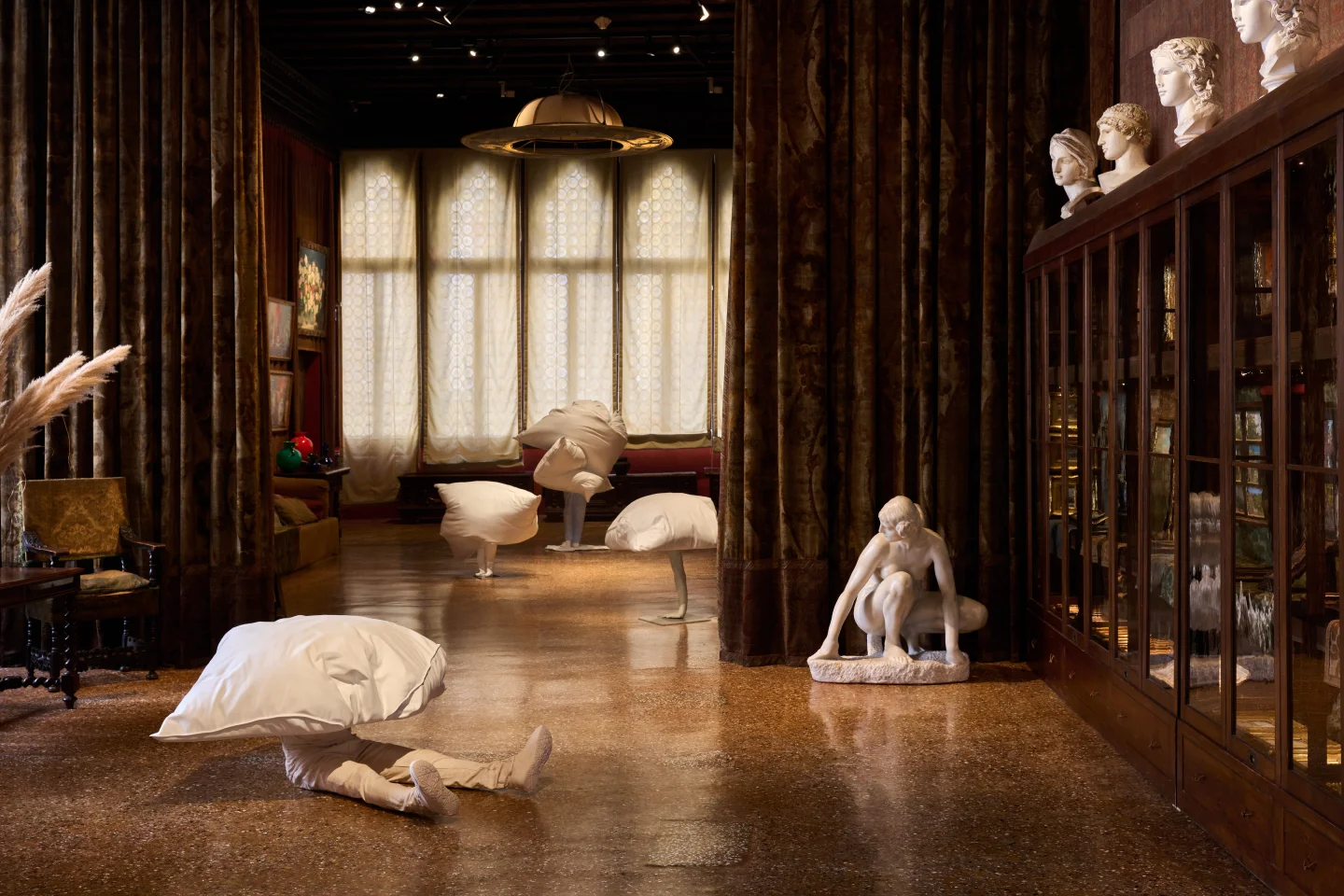
In the ‘’Dreamers’’ series, this relationship becomes more psychologically charged. Large cushions appear to be supported by human legs, arms and feet, arranged in unstable and sometimes comic positions. At first, the works appear playful. Then something more ambiguous emerges. The cushion belongs to the world of comfort, sleep and retreat.
The human limbs suggest a body that is present but strangely displaced. The objects appear almost alive, while the human being becomes fragmented. The works occupy the uncertain territory between physical reality and the unconscious. They ask what happens when comfort becomes a form of withdrawal. The dream, after all, is both refuge and suspension. It is a space in which the rules of the physical world temporarily disappear. Wurm gives that psychological state a body.
Clothing without the body
Perhaps the most sophisticated dialogue between Wurm and Museo Fortuny occurs in the relationship between the artist's *Substitutes* and Mariano Fortuny's experiments with clothing and fabric. Wurm's empty garments retain the shape or suggestion of a human presence without containing the person who once occupied them. The body has disappeared. The garment remains. This turns clothing into a kind of sculpture of absence.
A shirt or coat is no longer simply an object of fashion. It becomes evidence of a body that is no longer there — a shell, a trace, a memory. The comparison with Fortuny's *Delphos* is therefore particularly revealing. Fortuny revolutionised the relationship between fabric and the body. His pleated silk dress did not simply dress the body; it responded to it. The fabric came alive through movement. The body completed the garment. Wurm takes the relationship in another direction.
His empty garments suggest what remains when the body has withdrawn. Presence becomes absence. Movement becomes residue. The garment becomes a record of a human gesture that has already ended. This is one of the most compelling conceptual bridges between the two artists.
Fortuny and Wurm: two laboratories of transformation
Mariano Fortuny and Erwin Wurm belong to radically different historical moments, yet the encounter between them is not arbitrary. Fortuny was not simply a designer. He was an artist who refused disciplinary boundaries. Painter, inventor, photographer, set designer, textile innovator and experimenter, he treated Palazzo Pesaro degli Orfei as a total environment in which different forms of knowledge could interact. Wurm operates according to a similarly porous logic. He refuses to accept that sculpture must remain sculpture.
The object can become performance. The body can become material. Photography can become the memory of sculpture. Clothing can become architecture. The comparison reveals something fundamental about artistic innovation: it often occurs not within established categories, but at their borders. Fortuny expanded the possibilities of fabric. Wurm expands the possibilities of sculpture. Both are interested in transformation rather than permanence. And both understand the human body as the point where material acquires meaning.
A museum that cannot be neutral
This is why the Museo Fortuny is more than a backdrop for the exhibition. The building itself participates in the argument. Palazzo Fortuny carries layers of historical memory. Its architecture, interiors, textiles and objects create an environment in which the distinction between artwork and setting becomes difficult to maintain. In a conventional white cube, Wurm's sculptures could be read primarily as contemporary objects. Here, they are forced into dialogue. The past is unavoidable. Every contemporary gesture takes place against the accumulated authority of the building. This creates a productive tension.
Wurm's work is unstable. The museum appears stable. Wurm questions permanence. The palazzo embodies it. Yet Venice itself complicates this distinction. The city is one of the world's great monuments to impermanence. Its beauty depends partly on its vulnerability. Stone, water, salt, weather and time are in constant negotiation. Venice looks eternal precisely because it is constantly threatened by disappearance. Wurm's sculptures operate through a similar paradox. They are temporary, yet memorable. Fragile, yet conceptually persistent. Comic, yet unsettling.
The politics of posing
The exhibition ultimately becomes a meditation on something much larger than sculpture: the politics of the pose. To pose is to assume a position. But it is also to perform an identity. Contemporary life is saturated with poses — physical, social and digital. We curate our images. We construct professional identities. We learn the codes of luxury, success, sophistication and cultural relevance. We present ourselves to institutions, audiences, employers, followers and potential partners. The self becomes increasingly performative.
Wurm's art makes that performance visible by exaggerating it until it becomes absurd. His bodies are uncomfortable because they reveal how uncomfortable the performance of identity can be. The laughter they produce is therefore slightly unstable.We laugh at the person trapped between a chair and a bottle. Then we recognise the mechanism. We too are constantly arranging ourselves in relation to objects, expectations and other people's gaze. The difference is that Wurm asks us to hold the pose for one minute. Contemporary society sometimes asks us to hold it indefinitely.
What remains when the pose disappears?
This may be the question at the heart of the exhibition. If the body is sculpture, what happens when the body moves? If identity is performance, what remains when the performance ends? If objects help construct who we are, who are we without them? And if a photograph preserves the moment, does the image become more real than the experience itself? Wurm does not resolve these questions. He makes them physical. That is the strength of his work.His sculptures do not illustrate philosophical ideas; they allow the ideas to happen in front of us. The visitor bends, balances, performs and becomes temporarily ridiculous. And in doing so, the visitor discovers that the boundary between observing art and becoming art is far less stable than the museum usually suggests.
The encounter between Erwin Wurm and Mariano Fortuny ultimately becomes a dialogue about transformation. Fortuny transformed fabric into an extension of the body. Wurm transforms the body into an extension of sculpture. Fortuny created environments in which art, technology, fashion and architecture could converge. Wurm creates situations in which sculpture, performance, photography and everyday life become inseparable. Both artists challenge the idea that art belongs to a single category.
And both remind us that innovation often begins with a simple act of looking differently at something we thought we already understood. A garment. A chair. A cushion. A body. A museum. A city. In Wurm's hands, the familiar becomes strange enough to be seen again. Perhaps that is the most lasting effect of the exhibition. The sculptures may disappear. The pose may last only a minute. The body eventually leaves the room. But the question remains: When the pose dissolves, what remains of the self we were performing?
What endures is the act of seeing — and the possibility that, for a moment, we might see the ordinary differently.