GLANZSTÜCKE: Van Cleef & Arpels High Jewelry × Masterpieces from the MAK Collection
At Vienna’s MAK, approximately 500 objects come together in an ambitious encounter between two very different, yet profoundly connected worlds: the 120-year history of the Parisian High Jewelry Maison Van Cleef & Arpels and the extraordinary breadth of the MAK Collection.
The result is less a conventional jewellery exhibition than a journey through the history of decorative arts — one in which jewellery, textiles, furniture, fashion, architecture, technology and contemporary ideas of design continuously reflect one another.
At its heart lies a simple but powerful idea: excellence has no single period, material or discipline.
Van Cleef & Arpels was founded on Paris’ Place Vendôme in 1906, following the marriage of Alfred Van Cleef and Esther, known as Estelle, Arpels.
The MAK, meanwhile, dates back to 1863 and today stands as one of the world’s oldest museums dedicated to applied arts, encompassing design, architecture, fashion and contemporary art.
Their collaboration creates an unexpected bridge between Paris and Vienna, between jewellery and the wider decorative arts, and between historical objects and the continuing evolution of design.
Around 350 creations from the Van Cleef & Arpels Collection meet approximately 160 works from the MAK Collection.
The Maison’s patrimonial collection itself tells a story of preservation. Initiated in the 1970s, it was shaped in part by Jacques Arpels, who began reacquiring historic Van Cleef & Arpels creations in order to preserve representative examples of the Maison’s language and craftsmanship for future generations.
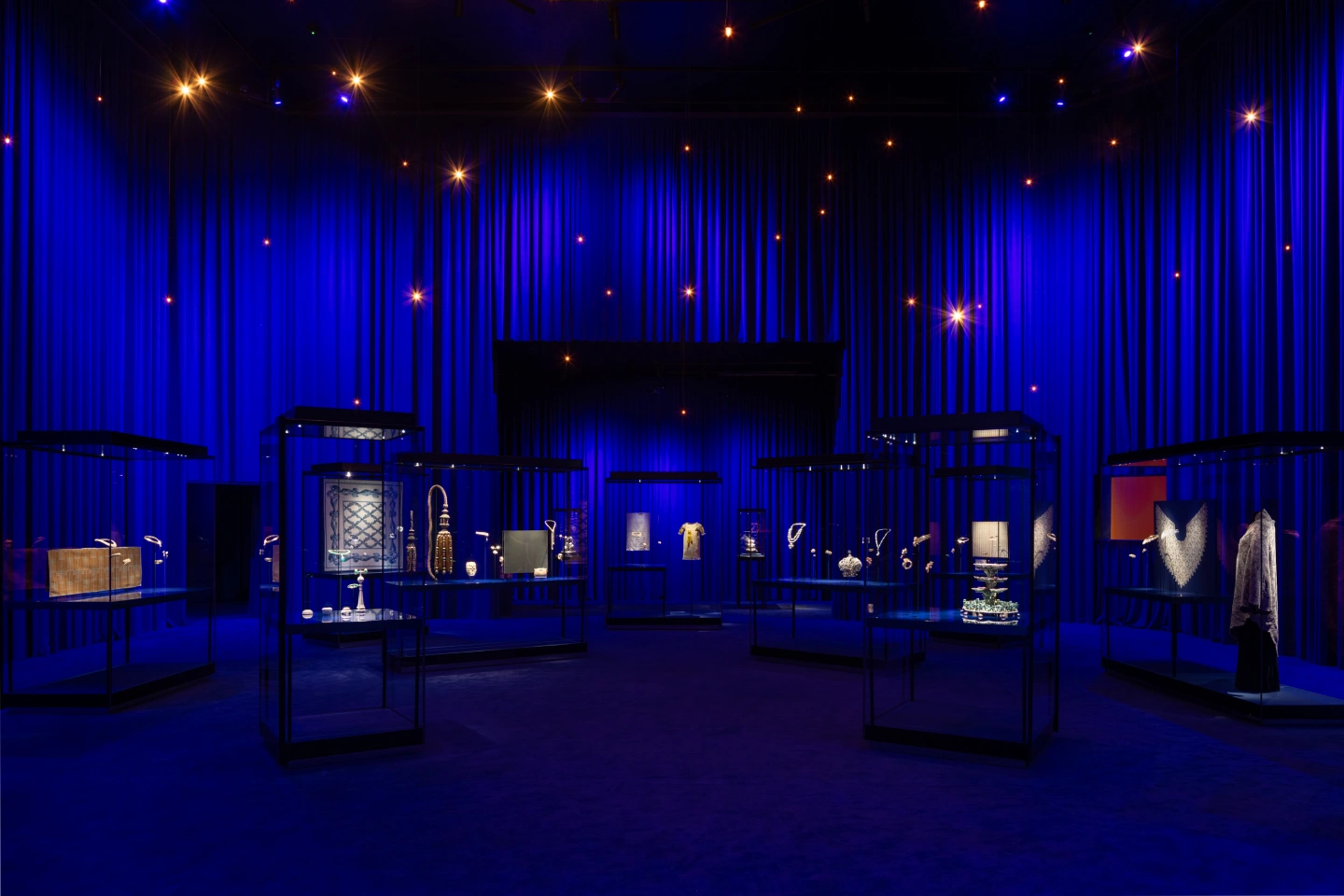
The exhibition unfolds through six thematic chapters: Wanderlust, Architecture, Rhythmic Designs, On Stage, Metamorphoses, and Nature & Cosmos.
The scenography, conceived by Atelier Tsuyoshi Tane Architects (ATTA), takes the form of a maze. Visitors move through a sequence of spaces in which jewellery and objects from the MAK Collection appear not simply as individual masterpieces, but as parts of a larger visual and intellectual landscape.
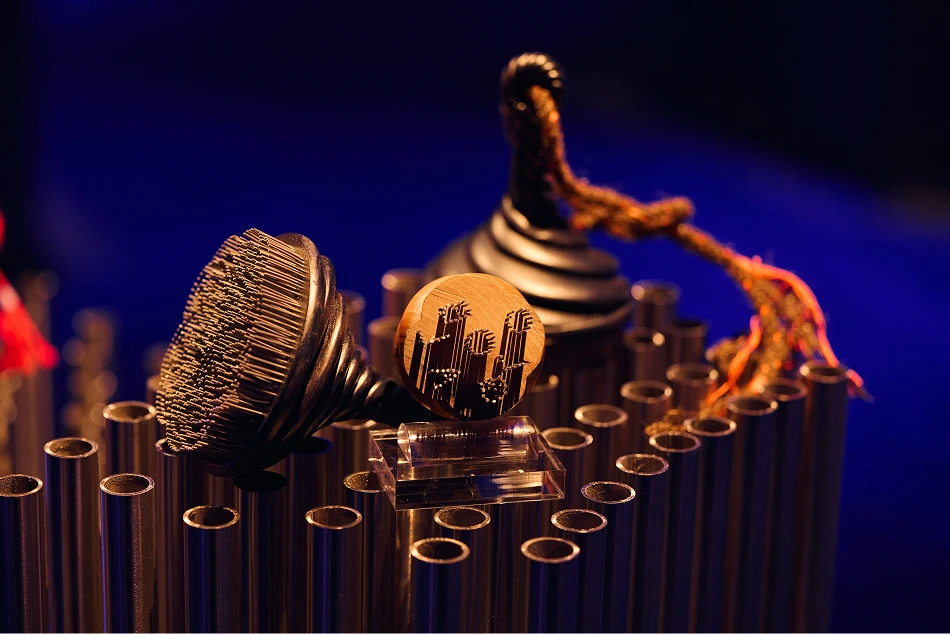
Among the most intriguing objects is a miniature sailing yacht created by Van Cleef & Arpels in 1906. The Varuna is crafted from gold, silver and jasper, capturing the movement of a sailing vessel in precious materials.
But its beauty is accompanied by ingenuity: concealed within its funnel is an electronic bell system designed to summon a butler.
Placed alongside it is the MAK’s extraordinary Portuguese Carpet, dating from the early 17th century.
The carpet depicts ships carrying passengers in European dress, surrounded by sea monsters and turbulent waters. Its imagery evokes an age of exploration, exchange and global movement.
Together, the yacht and carpet transform travel into a visual language — one expressed through both jewellery craftsmanship and textile art.
One of the exhibition’s fascinating objects is the Minaudière, patented by Van Cleef & Arpels in 1933.
Conceived as a highly sophisticated vanity case, it combines elegance with functionality. Its interior is carefully divided into compartments for objects such as a powder box, watch, lighter and lipstick.
Its restrained, envelope-like form reflects the modernist spirit of the 1930s.
Across from this language of modernity stands a much earlier masterpiece: a classicistic card table created in 1775 by the celebrated cabinetmaker David Roentgen.
The table contains compartments and playing surfaces for cards, chess and backgammon, while its upper surface incorporates chinoiserie executed in exotic woods.
Here, craftsmanship becomes almost a form of painting — except that the artist works with wood rather than pigment.
The third chapter, Rhythmic Designs, explores pattern and repetition.
Geometric textiles from the MAK Collection encounter Van Cleef & Arpels creations whose structures translate rhythm into jewellery.
The Silhouette Flower clips, created in the late 1930s, are particularly revealing. Their stylised floral forms demonstrate how the language of nature could be transformed through the geometry of late Art Deco.
This dialogue also brings the Wiener Werkstätte into focus.
Founded in Vienna at the beginning of the 20th century, the movement radically reconsidered the relationship between art, design and everyday life. The MAK holds its extensive archive, including thousands of designs and textile patterns.
In this context, the exhibition makes an important point: what we now recognise as the visual language of modern design was already being developed through the disciplined relationship between geometry, repetition, material and craftsmanship.
On Stage explores opera, dance, music and the culture of performance — themes deeply embedded in Vienna’s identity.
Following the Congress of Vienna in 1815, the city developed into an important centre of European ball culture. A white silk ball gown from the 19th century, preserved in the MAK, embodies this world through its elaborate sculptural silver embroidery.
More than a century later, Van Cleef & Arpels introduced another form of theatricality.
During the Second World War, dancers, fairies and feminine figures entered the Maison’s visual universe, offering images of poetry and hope.
The Little Winged Fairy clip is one of the objects that captures this transformation of jewellery into a miniature stage — a world where precious stones become characters and movement becomes narrative.
Perhaps one of the most compelling ideas in GLANZSTÜCKE is transformation itself.
The chapter Metamorphoses explores objects capable of changing their function, appearance or meaning.
A folding screen by Koloman Moser, created in 1906, is presented alongside one of Van Cleef & Arpels’ most innovative creations: the Zip necklace.
Patented in 1938, the Zip necklace can be transformed into a bracelet.
Its inspiration came from the zipper used in aviators’ suits — a piece of functional technology that had entered the vocabulary of fashion during the 1920s and was subsequently embraced by designers such as Elsa Schiaparelli.
The necklace, first created in 1950, demonstrates how Van Cleef & Arpels repeatedly transformed elements of contemporary life into objects of luxury.
Moser’s folding screen offers a parallel story. Decorated with gold leaf and collages, it reflects the influence of Japanese aesthetics and their transformation within Viennese Modernism.
Two objects from different disciplines and cultural contexts thus arrive at the same idea: design becomes powerful when it refuses to remain fixed.
The exhibition concludes with perhaps its most timeless theme: Nature & Cosmos.
Flowers, animals and celestial bodies have long occupied the imagination of both artists and jewellers.
The Chrysanthemum clip offers a spectacular example of Van Cleef & Arpels’ technical mastery.
It employs the Maison’s celebrated Mystery Set, patented in 1933, a technique that allows gemstones to be mounted so that the metal setting remains invisible.
The result is an illusion of pure colour and volume — as though the stones themselves had grown into the form of a flower.
Nearby, the MAK’s armillary sphere, dated 1553, connects beauty with scientific knowledge.
Its rotating metal rings represent the movement of celestial bodies and allow astronomical coordinates to be calculated, while zodiac imagery is engraved into the outer ring.
Here, jewellery and scientific instruments ultimately meet around the same human impulse: the desire to understand, represent and possess a fragment of the universe.
What makes GLANZSTÜCKE particularly compelling is that it does not present luxury as an isolated category.
Instead, it places High Jewelry within the much broader history of human creativity.
And a flower can become both a botanical form and an extraordinary technical achievement.
This is where the exhibition becomes particularly relevant to the contemporary cultural conversation around luxury.
Luxury, at its most meaningful, is not simply about rarity or price. It is about knowledge, time, material intelligence, craftsmanship and the preservation of ideas.
GLANZSTÜCKE makes that relationship visible.
It also demonstrates why museums such as the MAK remain essential to understanding contemporary luxury. Without the historical vocabulary of design, today's innovations can easily appear disconnected from the past.
Perhaps the most significant achievement of GLANZSTÜCKE lies in the encounter itself.
The exhibition ultimately suggests that innovation rarely emerges from isolation. It grows through dialogue — between disciplines, cultures, periods and ideas.
And perhaps that is the most enduring lesson of this encounter in Vienna: the masterpieces of tomorrow are often born when we learn to look at the masterpieces. For visitors wishing to explore the exhibition beyond the galleries, MAK is also offering an extensive supporting programme.