Karl Singporewala: Returning to the Question
Identity, memory, and belonging lie at the heart of Karl Singporewala’s artistic and architectural practice.
Karl Singporewala is a Parsi-born British artistic, architect and elected Royal Academician of Art at the Royal West of England Academy. Studied architecture at Leicester School of Architecture, De Montfort University, post graduate architecture at University of Brighton and then a further post graduate at the Bartlett, University College London. He was made an honorary community fellow of SOAS University of London in April 2025.
Drawing on his Parsi heritage while embracing the realities of contemporary diasporic life, Singporewala explores how cultural traditions can evolve without losing their meaning. His sculptures reinterpret ritual objects not as static symbols of the past, but as living forms that invite new ways of remembering, gathering, and imagining the future.
In this conversation, Singporewala reflects on the fluid nature of identity, the role of architecture as a vessel for cultural memory, and the delicate balance between preservation and transformation. Rather than seeking definitive answers, he proposes that heritage endures through reinterpretation, offering new points of orientation for generations still finding their place within an evolving cultural landscape.
CDH Talks: The Parsi community is often associated with a long-standing tradition linking ethics, education, craftsmanship, philanthropy and cultural heritage.
In your case, this heritage appears to be reflected in your work and creative practice. What does it truly mean to be Parsi today?
Karl Singporewala: It's really interesting because my art work has long been linked to personal identity and circumstance. For me, recent memory is just as important as heritage, yet the term 'Parsi' is an ethno-religious designator, where I find the broader term of Zoroastrian draws in a wider cultural background. The Parsi label links specifical to a Zoroastrian ancestral migration between Persia and India over a millennia ago. While I identify as a Parsi (complete with a super happy 80s Bombay Navjote party bonanza), I often wonder what the post-colonial designator for second-generation Parsis in the United Kingdom will be labelled in textbooks of the future. A minority, in a minority, in a minority.
Identity is a fluid concept which mixes many aspects of life, including societal, professional, and culturally. Linking both professional and cultural backgrounds is nothing new to Parsis. One only has to look at the beautiful array of '-walla / -wala' type surnames which Parsi only adopted in the 19th Century and you can see what was on the mind of your recent ancestors. For example, in this day and age, if we were doing this surname exercise now, I would have probably called myself Karl Architectwala.
This naming identity indicator fascinates me, because when you have generational harmony, this is the secret to immortality and legacy. However, it can also carry generational trauma and baggage. The weight of ancestry casts a long shadow.
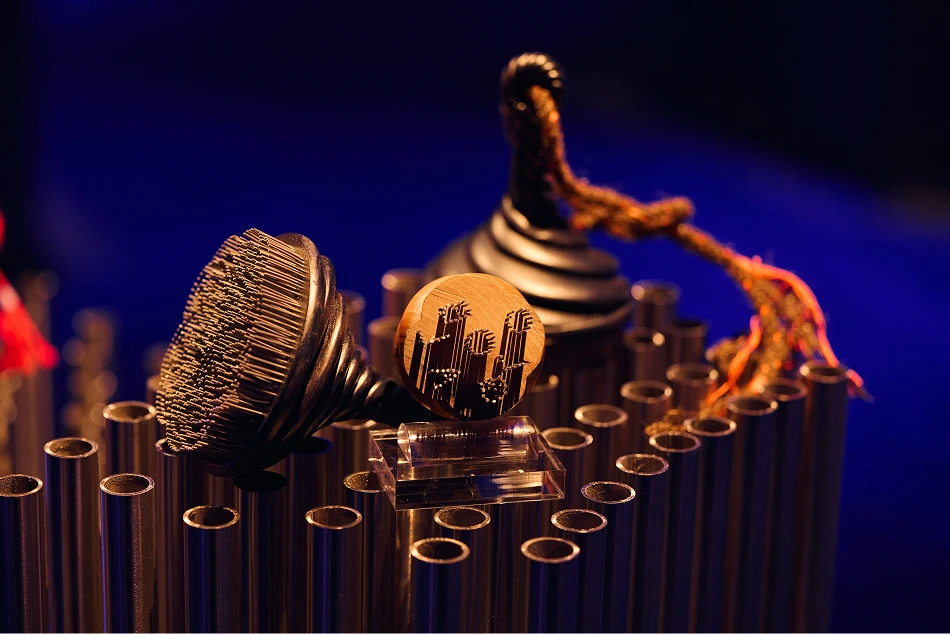
CDH Talks: The installation ''Lighthouses'' reconfigures the ritual components of the Parsi Ses as monumental, vertical forms recalling obelisks and minarets. The scale of the work gestures toward an attempt to negotiate loss - of identity, heritage, and continuity in relation to origin.
As the title suggests, it invokes figures of guidance and return, operating between symbol and structure. Where does the discontinuity of identity become visible?
Karl Singporewala: In the lighthouse series, the discontinuity of identity occurs in the colour, material and style of the new ses objects. A typical Parsi ses is polished, german silver and generally ornate. My deconstruction of these matters likens these typical attributes to style and taste. Therefore, once these attributes are removed, you are left with the vessels themselves, primary geometric shapes. A ses made for a future generation, the playful nature of colour, form and learning takes centre stage. The idea that these could be physical spaces to inhabit and explore, talks to experience and pilgrimage.
The metaphor of a lighthouse works on a number of levels. Firstly the structure is usually a residence, a place to live. However, their function is there to warn you and stop you from getting too close, but like a lamppost in the dead of night, they can also light the way home. These contradictions accurately frame my current circumstances, which is why they are reoccurring themes in my art work.
CDH Talks: What occurs when the imperative of return emerges?
Karl Singporewala: I'm not sure return is ever to a place. It is more often a return to a question. For diasporic communities, there is a tendency to imagine origins as fixed, yet every generation inherits a different version of that origin. My grandparents' Bombay is not my parents' Bombay, and today it's different again. That's what I love about heritage, it is the fundamental ingredient needed to innovate. Return therefore becomes an act of translation rather than restoration.
In my work I am less interested in reconstructing a replica of some authentic past than in creating new rites of remembering. These sculptures are not replicas of inherited objects; they are propositions for future generations. They ask how cultural knowledge is carried forward when language changes, when geography shifts, and when people grow.
Perhaps that is where the lighthouse becomes important. It does not ask you to sail backwards. It simply offers a point of orientation. Sometimes knowing where you have come from is enough to decide where you are going next.
CDH Talks: If identity is increasingly fluid today, what role can architecture still play in anchoring it?
Karl Singporewala: Architecture has always been about more than buildings. And a building without its people is just an empty vessel. It needs to give physical form to memory and shared values. We instinctively associate identity with places: the family home, a town square, a street we grew up on. Even when those places disappear, or when we migrate away from them, they continue to shape how we understand ourselves. In that sense, architecture is a vessel for cultural memory. This will always be separate from style.
Yet identity today is increasingly mobile. Many people inherit multiple cultures, languages and traditions simultaneously. Rather than anchoring identity to a single location, architecture can provide a framework through which different histories coexist. That is the beautiful eclectic nature of modern sensibilities. We need to create spaces where memory can be rehearsed, adapted and passed on without becoming static or nostalgic.
As both an architect and an artist, I am interested in making buildings that behave more like a cultural artefact than simply a functioning building. The works in my studio are often architectural in scale, but they are also containers for storytelling and inherited knowledge. For a community as small and dispersed as the Parsis, the original question should not be answered with a particular architectural 'style', it should be answered with identifying what is needed spatially and as a fascinator to bring people together.
CDH Talks: If identity must continually evolve in order to remain alive, where do you draw the line between transformation and dilution? At what point does adaptation risk becoming cultural erasure?
Karl Singporewala: I find personal identities far more interesting and nuanced than collective identities. Diversity of opinion is a strength, not a weakness. I think you need both orthodox and liberal components to continue forward, this constant debate is healthy, and the extremes on both sides help balance the centre ground. This pendulum of life is constant. Cultural erasure comes in many forms, at its extremes, when the pendulum swings in one direction too far, you can almost guarantee the energy build up for the inevitable swing back in the opposing direction. And thus, when erasure occurs it comes under the spotlight and the act of erasure can sometimes make it even more popular.
This can also apply to architecture. In recent times, the destruction of the Temple of Bel in Palmyra Syria or even the Spire of Notre Dame Paris France helped throw a renewed fascination in design and histories of these structures, thus elevating their popularity.
Diasporic communities are interesting example, in that you find they take a snapshot of a community and move it elsewhere. These communities then develop in parallel but independently. Like twins at birth, they can be exposed to the same environments and experiences growing up, but they are inherently individual and will perceive the world differently right from the start. Perception is a beautiful individual part of life, it's not just shaped by place but also time.
In regards to what your ses should look like, this is about the individual, and more so a discussion about fashion and taste! If it makes you feel more devoted to polish your silver soparo cone before guests arrive, then be my guest.
CDH Talks: Who are you really making this work for? The community that remembers these rituals, or the generation that may never have known them?
Karl Singporewala: It interests me that editions of the small scale ses (Sense of Ses -available via Runjeet Singh Gallery) have sold not just to Parsis. My artwork is not meant to be scholarly in nature, its observational. I've just been really blessed that collectors and patrons continue to support my work and enjoyed seeing the world through my eyes. I think sharing this observation with the generation that may never know them is an act of legacy.
Situations, emotions – my artwork is always a manifestation of this. I often think that I would have expired long ago, if I lacked the ability to translate my circumstance into artwork. Imbuing these objects with that circumstance allows me to both 'let go' and 'never forget'. They are my own monuments and memorials.