Letter to Time I Mauro Carrarro
CDH Talks: In a world where time is increasingly measured, quantified and accelerated, your Letter to Time introduces a more personal and contemplative relationship with it.
What inspired you to transform the timepiece from an object of precision into an object of personal expression?
Mauro Carrarro: My work begins with the desire to look at the world through my own artistic lens. It might be a face, a place or an object. Watchmaking entered my practice almost by chance. For Watches and Wonders in the City, Montblanc commissioned me to interpret its Iced Sea watch for illustrated materials. It was the first time I had drawn a watch in my signature blue ink. During the same event, I was also drawing portraits live in the boutique, sometimes including the watches people were wearing.
It was only several months later that I began to explore watchmaking more deeply. I was struck by the diversity of the maisons, their forms and their stories. Yet Letter to Time did not begin as a theoretical reflection on time. I had already been writing poems on the backs of my portraits. When watches themselves began to become portrait subjects—often seen straight on, almost as though posing for me—that gesture of writing naturally found a new recipient.
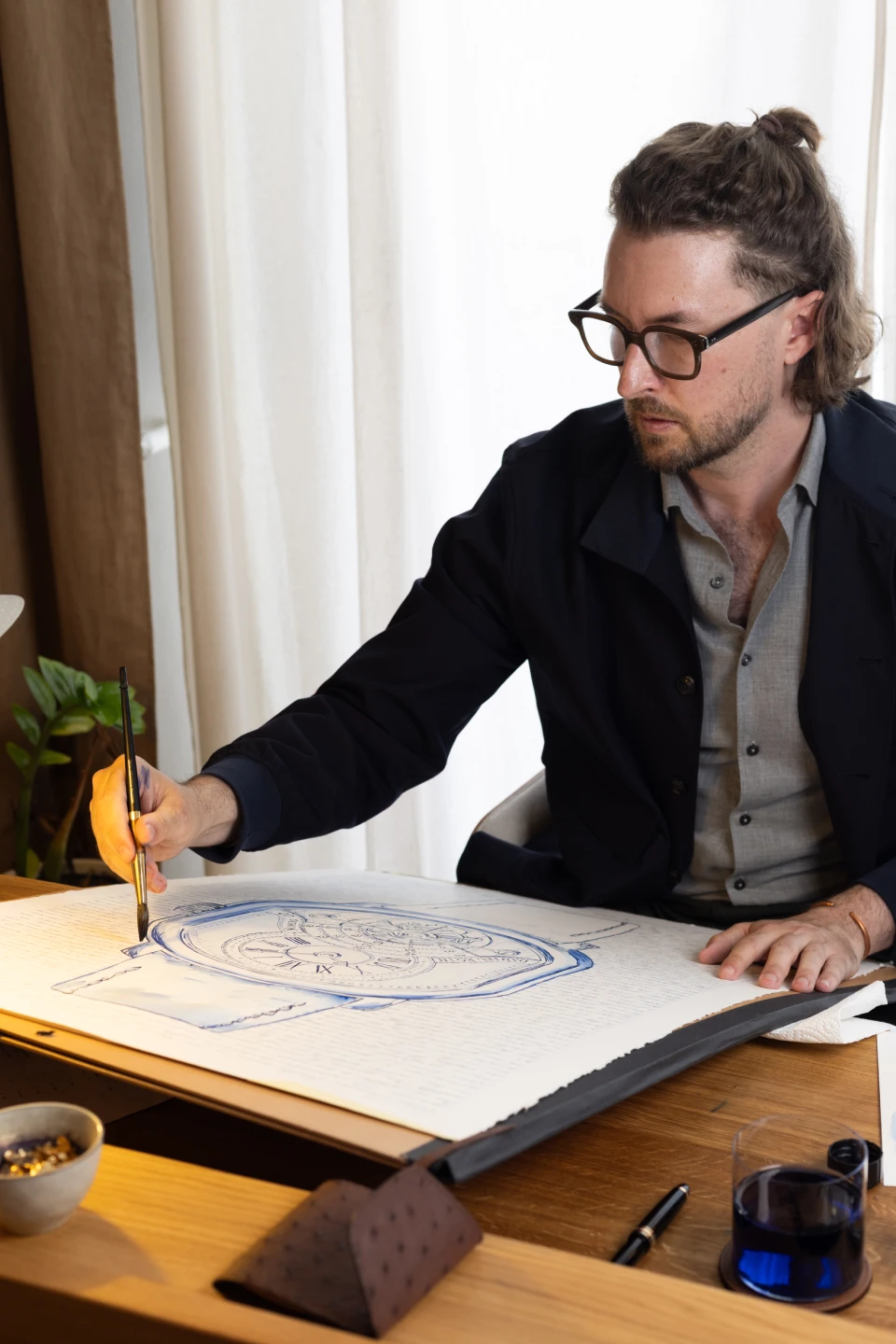
To draw a watch is to spend time with it. From a distance, I may simply be attracted to its beauty. But as I draw, I have to look at every index, every hand, every detail of the case and dial. It becomes a slow form of discovery, different from the knowledge of a watchmaker, but deeply personal. Eventually, I find myself addressing the object directly, almost as if it were someone with whom I had shared a moment. The name Letter to Time then felt inevitable: not simply an illustration accompanied by a text, but a dialogue with the watch and with the time we have spent together.
CDH Talks: Geneva has a remarkable heritage of watchmaking, where precision, craftsmanship and attention to detail have been cultivated over centuries. How does this cultural and artisanal tradition influence your artistic practice?
Mauro Carrarro: I came to Geneva as an animation film director, not as a watchmaking specialist. I do not come from a family of watchmakers, and for years I lived here without fully appreciating the richness of the world around me. When my interest in horology began, I was almost surprised to discover that I was living in one of its most important centres.
In Geneva, watchmaking is not merely a heritage to study; it is part of everyday life. When I return from travelling, even the watchmaking advertisements at the airport make me smile. There are boutiques, encounters, collectors, professionals and places such as Coffee Up, where people exchange news and share their passion. If I hear about a new model, I can often go and see it in person shortly afterwards, rather than encounter it only through photographs or press releases.
I have learned that a watch needs to be observed, ideally held in the hand, and that reading a dial is rather like learning a language. My studies with the Fondation de la Haute Horlogerie have given me valuable tools, but conversations in boutiques have been equally important. I love the small stories behind a complication, a collection or a manufacture: the ways in which people bring technical and human heritage to life.
That direct access nourishes my work. I would never claim to see a movement as someone who builds or repairs one does. I bring the perspective of an artist who is still learning, translating curiosity and respect for detail into a language of ink, gold and handwriting.
CDH Talks: Your bespoke commissions introduce an intimate dimension to the creative process, as each timepiece can become connected to a particular memory, story or private text.
How do you translate someone else's personal experiences into an artwork while preserving your own artistic identity?
Mauro Carrarro: Artistic freedom and the client's ten words
There are two ways a Letter to Time can begin. Some works are spontaneous. I encounter a watch that fascinates me, add it to a list of possible subjects, and wait. Weeks or months may pass before I genuinely feel the need to draw it. Each work takes time and energy, so there has to be a real conviction—almost a period of falling in love. That is why some letters begin, in spirit, with the words, “At last, we meet.” It is the moment when a watch ceases to be merely something I admire and becomes the subject of a private encounter.
The writing on the back emerges from that dialogue. I do not always aim for perfectly legible calligraphy. Sometimes the hand becomes more nervous and spontaneous, and certain passages remain almost between the watch and me.
When the work is commissioned, however, I begin by listening. I usually ask the client for ten words or references: names, dates, places, memories, or technical details such as a tourbillon or a retrograde hand. I do not necessarily ask them to write the letter themselves. Those ten elements become something like an open score.
I write in the moment, without composing the entire text beforehand. I think of it as a form of poetic improvisation, almost like spoken-word performance: each word has to find its place, but the journey remains free. The client entrusts me with the essential elements of their story. I preserve their meaning without giving up my own voice. That trust is what makes a truly personal work possible.
CDH Talks: Certain objects carry meanings that go far beyond their material or functional value. A watch, for example, can represent a family inheritance, a personal achievement or a significant moment in someone's life.
Do you believe that objects can become carriers of personal identity and collective memory? How does this idea influence your work?
Mauro Carrarro: A mechanical watch already contains something astonishing. It comes to life through the energy we give it, whether by winding it or through the movement of the wrist. I also think of Jaeger-LeCoultre’s Atmos clock, which draws energy from changes in temperature. Such objects can almost seem alive. I am not a watchmaker, but I try to understand them with respect, including through drawing. In my own way, I too try to enter their world.
Sometimes, when looking at a limited edition of twenty watches, I imagine that my interpretation on paper might symbolically become the twenty-first. It is not another watch, of course, but another way for that particular piece to exist through art.
Many Letters to Time are created for someone from the outset. A collector wishes to thank a watchmaker; two enthusiasts exchange a gift; a maison wants to honour a client or mark an occasion. In such cases, the artwork is not only about the object. It is about a relationship. I have heard of recipients being moved to tears by a letter they received. I understand why: in a world where almost anything can be bought, receiving something conceived and made specifically for us carries a different kind of value.
There is also a practical aspect I love. A rare watch may spend some of its life in a safe, while its portrait can remain on view every day. The artwork becomes a presence, a visible reminder of the object and the story attached to it. I have made relatively few of these letters so far, mainly because they take time and are often created for a particular recipient. Their rarity is not an artificial strategy; it follows naturally from the way I work.
CDH Talks: The world of fine watchmaking is closely connected to luxury, heritage, exclusivity and craftsmanship. Your artistic practice creates a different way of engaging with these values.
How do you see the relationship between contemporary art and the luxury industry? Can artistic interpretation introduce a new dimension of meaning to objects traditionally associated with luxury?
Mauro Carrarro: I did not deliberately set out to enter the luxury world. My artistic language found its place there quite naturally. Perhaps that is because I work with tools and materials that have strong identities: fountain pens, blue ink, genuine 24-carat gold leaf, and carefully selected paper. These are old, seemingly simple gestures, but they demand experience, control and sensitivity.
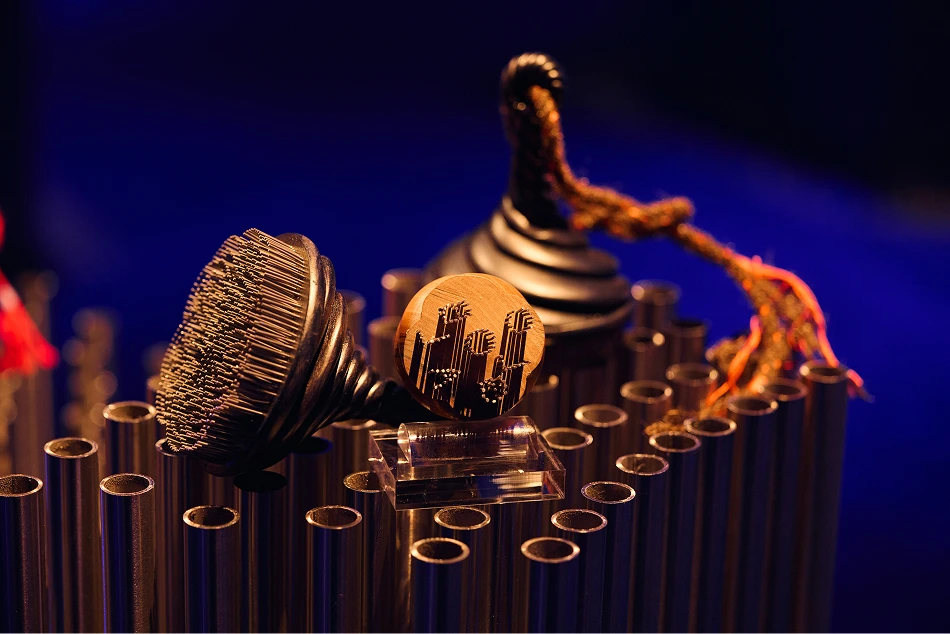
Over time, I have continued to develop this practice. At first there was mainly blue ink; then came gold. Today I am also exploring relief, volume, Bologna gesso and blue bole, to give indices, hands and other details a different physical presence. I am not interested in adding precious materials simply to make a work appear more valuable. I want to discover what each technique can express, and how it can intensify the experience of looking at the work.
That attention extends to the tools around me. Some of my studio accessories, including holders for ink and gold leaf, are made by other artisans. I also collaborate with photographers familiar with the visual language of the great maisons. I like the idea that even the objects and people supporting my practice embody their own skills and distinctive gestures.
Luxury, when rooted in genuine savoir-faire, can recognise itself in this approach. But art should not merely confirm an object's prestige. It can offer another perspective, more intimate and less functional. Above all, I want to elevate beauty: to give something beautiful the time, attention and freedom to be contemplated.
CDH Talks: On 10 October 2026, you presented a new Letter to Time at the Musée d’Art et d’Histoire in Geneva, as part of the World Watch Day programme.
What did this particular presentation mean to you, and how did the setting of the museum influence the way you approached the work?
Mauro Carrarro: When I learned that World Watch Day invited enthusiasts and people connected to watchmaking to contribute in their own way, I thought I could take part through a Letter to Time. I was drawn to the collective, non-profit spirit of the initiative. It was also new territory for me, as I had very little experience with auctions.
The date, 10 October, immediately suggested a visual idea: watch hands are so often shown at approximately ten past ten, a balanced and instantly recognisable position. I love it when a project has such a clear internal logic. I imagined a work built around 10.10.2026, making the date itself a central visual presence. Rather than reproduce a conventional dial, I played with a composition that was almost poster-like, without relying on ordinary hands to indicate the time.
The letter on the reverse took a different tone from my private commissions. It was dedicated to my personal journey into watchmaking and to the generous people who have welcomed me, explained things to me, shown me watches and taught me along the way. I did not want to speak on behalf of every enthusiast. Each person experiences this world through different encounters and discoveries. I could only tell the story of what I myself had lived and absorbed.
Presenting the work in the context of Geneva’s Musée d’Art et d’Histoire, during a day devoted to watchmaking, gave that personal gesture a special meaning. I approached the initiative without particular expectations, and was genuinely surprised by the attention it received from specialist blogs and watchmaking media. I am grateful to World Watch Day, the Fondation de la Haute Horlogerie and everyone who helped bring visibility to the work. Above all, though, the piece remains a thank-you, expressed through drawing and handwriting, to a world I have come to know one encounter at a time.
CDH Talks: A timepiece often accompanies us through important moments in life, carrying memories, personal achievements or connections with the people we value.
If someone were to commission a Letter to Time, how could their own story, memories or relationship with a particular timepiece become part of the artwork? What would you invite them to consider when imagining a piece that is uniquely theirs?
Mauro Carrarro: When someone approaches me about a Letter to Time, we do not necessarily begin with a single watch. A collector may own several pieces, and we can consider different possible subjects together. I want to understand not only which watch would make a beautiful drawing, but what story the person hopes to tell and what feeling the work should convey.
The first step is almost always a conversation, in person or by video call. I prefer a genuine exchange, because not everyone has the time or inclination to write a complete poem. Often ten words are enough: names, dates, places and details with a particular meaning. Some clients want the textures, polished or brushed finishes and distinctive features of a bespoke watch to be rendered with great care. Others imagine a more nervous or mysterious line. Together, we look for the balance between fidelity to the watch and my freedom to interpret it.
I also guide the person commissioning the work through choices such as framing, mount and finishes. Sometimes we can photograph the stages of creation or produce a carefully lit, high-resolution photographic reproduction of the finished artwork. These options allow the process itself, not only the result, to be preserved and shared.
When the work is a gift, surprise matters enormously. I can even deliver it personally, meeting the recipient and witnessing the moment they discover the portrait. That is when I realise the story no longer belongs only to the person who commissioned it. There are three of us: the commissioner, the artist and the recipient. The presentation becomes almost a small ceremony, a passing of something meaningful from one person to another. Through the artwork, I briefly become part of their story too.
CDH Talks: As digital technologies increasingly shape our relationship with time, memory and communication, your project returns to two fundamentally human forms of expression: drawing and handwriting.
How do you envision the future of Letter to Time, and are there particular collaborations or cultural contexts in which you would like to develop the project further?
Mauro Carrarro: Drawing in ink began for me partly as an escape from animation filmmaking. A film can take years of development, preparation and production. Its stages overlap, and it is not always easy to say when something is truly finished. I felt a need for a practice in which I could reach a tangible result on a timescale closer to everyday life.
Above all, I wanted to work without an “Undo” button. That is why I often draw directly with a fountain pen, without first sketching in pencil. Every mark is a decision; mistakes and imperfections belong to the work. I am not looking for a photographic reproduction of a watch. Some artists spend hundreds of hours producing extraordinarily precise illustrations, but my ambition is different. I want the gesture to remain visible, and the urgency of telling a story to be felt.
Ink itself imposes a rhythm. Shading and washes must be worked while the material is still responsive. On the reverse, I sometimes write for one or two hours without stopping. It is a liberating moment, almost an expressive necessity. That immediacy is something I want to preserve.
I am not opposed to digital technology at all. It is fundamental to my training as a filmmaker and to the way I present and organise my work. But I want the heart of the creative act to remain analogue. Technology can help people discover an artwork, document it and share it, without replacing the gesture that brings it into being.
Moving from live drawing to a studio practice has also allowed me to explore techniques that require more time. I now experiment with Bologna gesso, blue bole, burnishing and subtle relief. Some stages need a full day to dry, and a single work may take one or two weeks. I am interested in making ancient craft gestures my own, interpreting them in a personal way. For me, the future of Letter to Time is not about becoming faster or more perfect. It is about enriching the language without losing the energy of the first mark. As for future collaborations, I prefer to let them grow out of real encounters and opportunities rather than announce projects before they take shape.