Michele Chiocciolini The Red Heart’s Impulse Against the Dark World
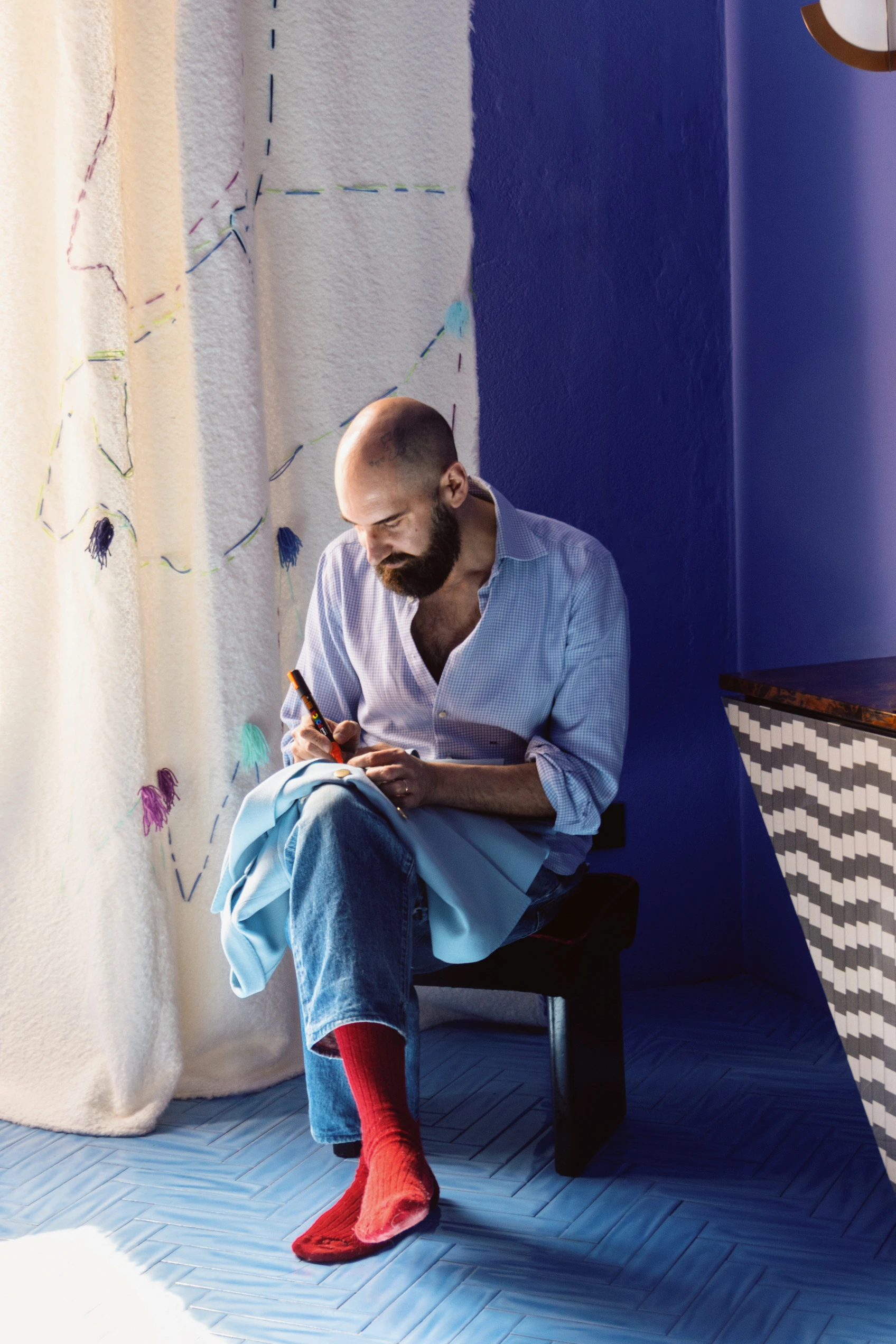
In contemporary visual culture, where the boundaries between art, design, and symbolic communication are increasingly fluid, Michele Chiocciolini occupies a space that resists easy categorization. Based in Florence, his practice moves between fashion, graphic art, and object design, drawing from a layered visual vocabulary that includes pop art references, Italian craftsmanship, and a strong instinct for emotional storytelling.
His work is defined by a sense of expressive freedom, where imaginery is not reduced to decoration but functions as a carrier of mood, energy, and cultural resonance. Recurring motifs such as the red heart, animal figures are not used as fixed symbols, but as open emotional codes - intended to communicate vitality, warmth, and immediacy rather than institutional seriousness or rigid meaning.
Rather than operating within the logic of traditional luxury or fashion systems, Chiocciolini constructs objects that behave like visual fragments of a broader narrative - one centered on freedom, instinct, and the transmission of good energy.
CDH Talks: Dear Michele, your work often draws on symbols like the red heart and animal figures, which feel open and emotionally direct. How do you decide when a symbol carries enough meaning to stand on its own without explanation?
Michele Chiocciolini: What I call total or all-encompassing forms are symbols that I choose, but that sometimes also seem to choose me. They carry meanings rooted in significant moments of my life and emerge from memories that are not fully rational. They belong to a more intuitive and subconscious space.
They do not tell stories in a literal sense. They evoke states of feeling.
The palm tree takes me back to childhood summers and walks along the seaside, beneath tree-lined promenades. Animals, on the other hand, recall my grandparents’ farm and the illustrated books I used to browse as a child—stories of savannahs, jungles, the Amazon, and the tundra. Remote landscapes that expanded my imagination.
Even then, I felt a desire to belong beyond my immediate surroundings—to a wider ecological and emotional world. That sense of expansion still informs my work.
The heart is perhaps the most direct of these symbols. It is universal, immediate, and almost autonomous. It speaks of affection, but also of existence, presence, and belonging. It has become a language in itself within my practice.
CDH Talks: You speak through visual energy rather than fixed narratives. Do you think design today should communicate clarity, or is ambiguity an essential part of emotional impact?
Michele Chiocciolini: My work always originates from an inner condition, even when it is directed outward. That is why it often carries a dreamlike quality.
It is not designed to deliver information or fixed interpretation. It opens space instead—questions, tensions, and possible readings. I am less interested in clarity as an end in itself. I am more interested in encounter: between what I propose and what the viewer brings to it. Meaning emerges in that space. Not as a conclusion, but as a dialogue. What I try to convey is not a message, but an emotional experience that remains open to interpretation.
CDH Talks: There is a strong sense of freedom in your aesthetic language. What does “freedom” mean in a creative process that still operates within fashion and design systems?
Michele Chiocciolini: Freedom is something I have learned to protect within my practice. Of course, I work within systems—fashion, design, collaboration. These come with constraints, timelines, and expectations. That is part of the process.
But freedom must remain present, otherwise the work becomes functional but emotionally silent.
For me, freedom is what gives a work its resonance. Without it, everything is technically correct, but something essential is missing.I often describe it as a kind of invisible layer—something that cannot be planned. It is what allows instinct, accident, and imagination to enter the process.
That is where the work becomes alive.
CDH Talks: Your work prioritises emotional transmission—positivity, warmth, immediacy—over institutional seriousness. How do you maintain depth through such accessible codes?
Michele Chiocciolini: I do not see accessibility and depth as opposites. Some of the most profound things are also the most immediate. I use simple and recognisable forms—hearts, animals, natural symbols—but they are never empty. They are always rooted in lived experience, memory, or emotion. I am interested in entry points: forms that do not exclude the viewer.
From there, more layers can unfold over time, if the viewer chooses to stay with the work. I have never felt the need for complexity to signal depth. A simple image can hold enormous emotional density.
Depth comes from authenticity, not difficulty.
CDH Talks: If your objects are meant to carry “good energy” into the world, how do you know when a piece has succeeded once it leaves your studio?
Michele Chiocciolini: I would not reduce it to “good energy” alone. What interests me is something more nuanced. Behind a positive visual language, there is often a more complex emotional structure. Sometimes even a quiet tension.
I try to approach that complexity without negating it, but translating it into something that feels open, immediate, and almost instinctive. There is a childlike clarity in the surface, but not in the origin. Once the work leaves the studio, it enters a different space. It becomes independent. It may be read immediately—or not at all. That uncertainty is important to me.
The viewer completes the work in ways I cannot fully anticipate. And that is part of its life.
CDH Talks: What should we expect from you next? Can you share your plans?
Michele Chiocciolini: I see the future as something that should remain slightly unexpected. I want to expand my practice into new contexts—interiors, spatial projects, and collaborations beyond Italy, with a more international scope. I am particularly interested in engaging with the American art context. It is often reduced to simplified narratives, yet it has a deeply layered cultural and artistic history. I am drawn especially to the energy of American cities and to the neo-expressionist moment of the 1980s and 1990s, which resonates with parts of my own visual language.
Cities like New York, Los Angeles, and Miami continue to generate strong visual identities, often in tension with their own mythology. To work within that environment would mean entering a dense cultural dialogue. That is something I would very much like to pursue.