The Wild Within: Ryan Koopmans & Alice Wexell Return to New York
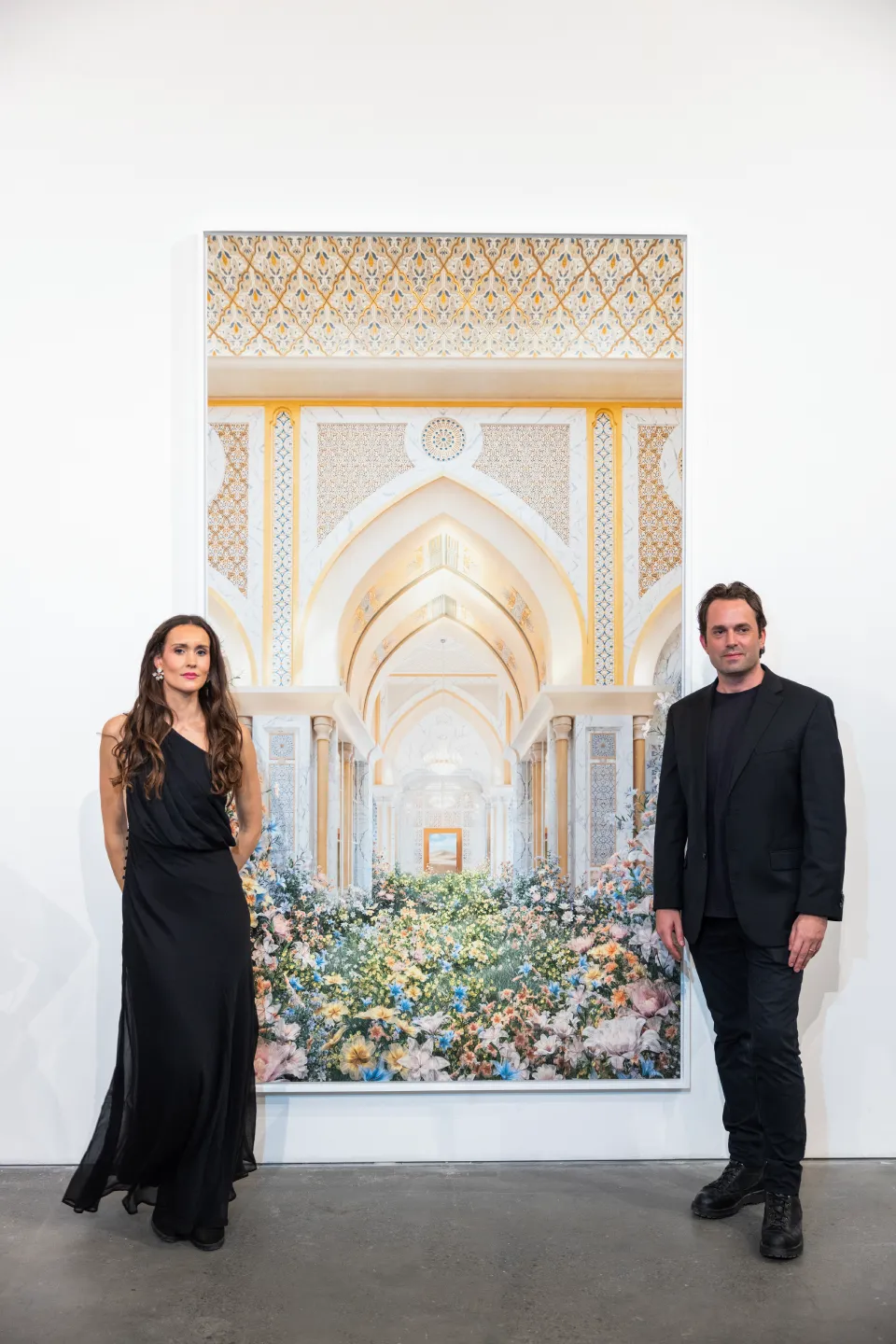
As "The Wild Within" arrives in New York on 10 September, following its presentation in Dubai, Ryan Koopmans and Alice Wexell unveil their latest exhibition within the intimate setting of Leila Heller Gallery's historic Upper East Side townhouse. Rather than simply relocating the project, the New York presentation reshapes the viewer's encounter with the artwork and introduces works that have never been exhibited before, inviting a slower, more immersive dialogue between architecture, photography, digital transformation, and memory.
Rooted in real architectural spaces yet expanded through digital reconstruction, *The Wild Within* explores the delicate threshold between documentation and imagination. Throughout the series, abandoned interiors become living environments where nature, light, and time gradually reclaim the built world, challenging conventional ideas of permanence and preservation.
In conversation with CDH Talks, Ryan Koopmans reflects on how architecture influences perception, why ambiguity remains central to their artistic language, and how the universal themes of decay, renewal, and cultural exchange continue to resonate across different places, audiences, and histories.
CDH Talks: In contrast to your previous exhibition at Leila Heller Gallery in Dubai, this New York iteration unfolds within a historic Upper East Side townhouse.
How did the architecture of the space influence the way the works were selected or installed?
Ryan Koopmans: The Dubai exhibition took place in a more expansive gallery setting, while the New York presentation unfolds within a more intimate Upper East Side townhouse environment. That difference naturally affects how the works are experienced. For this presentation, we wanted the works to respond to the character of the space rather than simply occupy it. The installation is approached with attention to rhythm, proximity, and atmosphere, allowing the viewer to move through the works in an intimate way. Because many of the works themselves are concerned with architectural interiors, there is a meaningful dialogue between the gallery setting and the spaces depicted in the images.
CDH Talks: There is a strong sense of intimacy in this presentation, both spatially and conceptually. How does scale affect your relationship to digital image-making?
Ryan Koopmans: Scale has a major effect on how digital work is experienced. At a larger scale, a screen-based work can feel immersive and architectural. It can create the sensation of entering a space.In a more intimate setting, the experience becomes quieter and more focused. The viewer can spend time with details, textures, subtle movement, and atmosphere. That is important to us because the work is not only about impact. It is also about the slower qualities of looking:light, time, stillness, and the tension between what is real and what has been reimagined.
CDH Talks: New York is not only a professional milestone for this exhibition, but also a deeply personal place in your shared history. In what ways, if any, does that personal dimension enter the work itself?
Ryan Koopmans: The work is not autobiographical in a literal way, but personal history inevitably affects how we see and respond to places. New York was formative for us, both personally and professionally, and it shaped our relationship to art, architecture, photography, and contemporary culture. That personal dimension enters the work more through feeling than through direct narrative. We are often drawn to spaces that seem to hold traces of the past while also suggesting transformation. Returning to New York with The Wild Within feels connected to that same idea: revisiting something familiar, but seeing it through time, memory, and change.
CDH Talks: The Wild Within often navigates the threshold between documentation and reconstruction. Where do you locate the line between observing a space and reimagining it?
Ryan Koopmans: The process begins with observation. We photograph real architectural spaces, and that photographic encounter is an important foundation of the work. From there, the image becomes a space for reconstruction and transformation. We are not trying to make a purely documentary record, but we also do not want to detach the work entirely from the real place. The line between observation and reimagination is where the project exists. The original site gives the work its structure, while the digital process allows us to explore what the space might become emotionally, visually, or imaginatively.
CDH Talks: Across the series, architecture and nature seem to exist in a continuous state of negotiation. What draws you to this tension between structure and organic transformation?
Ryan Koopmans: Architecture often carries ideas of permanence, control, history, and human ambition. Nature introduces a different kind of force: growth, time, decay, and renewal. We are drawn to the tension that happens when those two forces meet. In the works, nature is not simply decorative. It changes the atmosphere of the space. It softens, interrupts, and transforms the architecture. That relationship allows us to think about decay not only as loss, but also as a form of renewal.
CDH Talks: The works move between screen-based pieces, archival prints, and sculptural interventions. How do you think about materiality when the original image already begins in a digital space?
Ryan Koopmans: Materiality is central to how the work is experienced. Even when the image moves through a digital process, the final form changes the viewer’s relationship to it. The screen-based works introduce movement, light, and time. The archival prints allow the image to become still and contemplative. The wall sculptures bring the project into a more physical and tactile register.We are interested in the way the work can move between physical architecture, photography, digital reconstruction, and material form.
CDH Talks: Rather than presenting a fixed narrative, the project feels open-ended and atmospheric. How important is ambiguity in your approach to storytelling?
Ryan Koopmans: Ambiguity is important to us. We are not trying to tell a fixed story with a clear beginning and ending. We are more interested in creating images that feel open, atmospheric, and suggestive, and that are suspended in place and time. That openness allows viewers to bring their own associations and emotions to the work. We like that the work can hold several readings atonce without closing itself down into a single explanation.
CDH Talks: In many of the works, time feels both suspended and active at once. Are you interested in preserving memory, or in allowing it to evolve into something else entirely?
Ryan Koopmans: Both. There is a relationship to preservation in the work, because the images begin with real places and real architectural spaces. Photography has always had a connection to memory, and that remains part of the project. At the same time, we are interested in transformation. The works do not simply freeze a place as it was found. They imagine another possible state, where nature, light, and motion change the atmosphere of the space. So memory is preserved, but it is also allowed to evolve.
CDH Talks: Coming from a background in photography, how has your relationship to the photographic image changed through the development of this series?
Ryan Koopmans: Photography remains a foundation of the work, but our relationship to the photographic image has expanded. In The Wild Within, the photograph is not the final endpoint. It becomes a starting point for reconstruction, animation, and transformation. That shift has allowed us to think about the image as something more spatial and open-ended. It still begins with the real world, but it can move into a space between documentation and imagination.
CDH Talks: Leila Heller Gallery’s townhouse setting introduces a domestic scale to what is often experienced as monumental digital work. How do you see this shift affecting the viewer’s experience?
Ryan Koopmans: The townhouse setting changes the pace and intimacy of the experience. Rather than encountering the work only as something monumental, the viewer moves through a more human-scale environment. That shift is interesting. Since many of the images depict interiors,the setting encourages the viewer to experience the exhibition almost as a sequence of rooms or encounters. It supports a slower and more focused way of looking.
CDH Talks: As The Wild Within enters different cultural contexts, what do you hope remains as its universal language — the element that allows art to create connection beyond geography, history, and personal experience?
Ryan Koopmans: As The Wild Within moves through different cultural contexts, we hope its universal language is the cyclical nature of time: the way places transform, deteriorate, disappear, and, in some form, return to life.
Many of the buildings we work with are crumbling, abandoned, and actively vanishing in real life.
Through the artworks, we are not trying to reconstruct them literally, but to give them a new lease on life, reimagining them as living, breathing spaces where nature, memory, and architecture coexist.
The architecture itself also carries a universal quality.
Many of the sites reflect a fluid hybrid of cultural and architectural influences, where styles, traditions, and motifs overlap. That blending of cultures is important to us, because it reinforces the idea that these spaces are never fixed. They are shaped by time, movement, memory, and exchange.
That sense of renewal is what we hope remains timeless. Even when the specific history of a site is unfamiliar, people can understand the emotional power of something once forgotten being brought back into focus. The work speaks to decay, regeneration, loss, and continuity, experiences that reach beyond geography, history, and personal background.